
By Our Reporter
WORLD
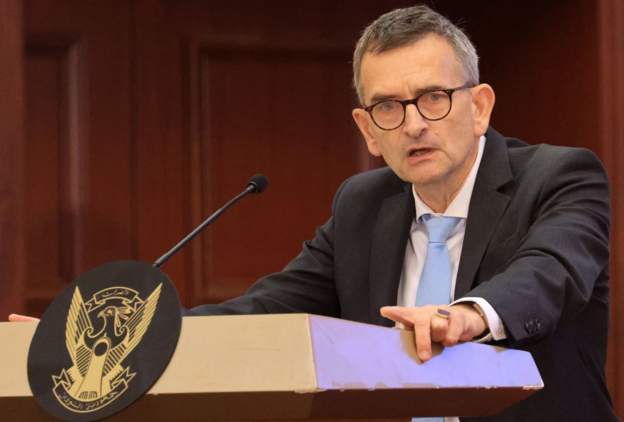
Sudan’s warring rivals have agreed to send representatives for negotiations, potentially in Saudi Arabia, the United Nations’ special representative in the country, Volker Perthes, said.
Mr Perthes told the Associated Press (AP) news agency on Monday that the talks would initially focus on establishing a “stable and reliable” ceasefire monitored by national and international observers.
He said the two sides had already named their representatives for preliminary discussions but cautioned that logistics for talks were still being worked out.
Mr Perthes also said that in the past week he had noticed a “change in tone” from the two warring sides, noting their realisation of how dangerous the situation had become and that any victory would be won at “too great a cost”.
No definite information is available on the when and where of the negotiations. The UN official said both sides would have to agree on the venue.
The mediation efforts continued as the two sides clashed in the capital, Khartoum, despite another three-day extension of a fragile ceasefire.
Explosions and sounds of gunfire were reported in parts of Khartoum and its neighbouring city, Omdurman, on Monday.
The two sides announced late Sunday they would abide by a 72-hour extension of their nominal ceasefire of the past week.
Meanwhile, Eritrea says the crisis in Sudan can be resolved by the neighbouring countriesImage caption: Eritrea says the crisis in Sudan can be resolved by the neighbouring countries.
Eritrean President Isaias Afwerki says the East African regional grouping, the Intergovernmental Authority on Development (Igad), should be given priority in resolving the ongoing crisis in Sudan.
He says that while that the current situation in Sudan is a matter of global concern and individual countries may express their interest, the Igad’s initiative can assist the Sudanese people to transition to a new political disposition that aligns with their aspirations.
The president said there was an urgent need for the “tragic and deplorable conflict” in Sudan to come to an immediate end and for there to be an unitary defence and security organ in the country.
He says Eritrea is willing to provide its best assistance to address the crisis in Sudan, but the people should also be allowed to address their challenges independently.
Mr Isaias said Eritrean sea, land borders as well as its airspace were open for Sudanese and others affected by the current conflict.
He, however, insisted that Eritrea was not willing to establish “refugee shops” but was willing to provide modest assistance to the Sudanese people.
He said the ongoing conflict was the result of the military leaders engaged in a power struggle without fulfilling their responsibility to ensure a peaceful transition to an elected government.


