
By Kayiira Edgar
MBALE
The Ministry of Agriculture, Animal Industry and Fisheries (MAAIF), in partnership with Eastern and Southern Africa Small-scale Farmers’ Forum (ESAFF) Uganda, is championing a national strategy to promote agroecology, a sustainable farming method.
This initiative is particularly focused on empowering women and youth, equipping them with the knowledge and skills to become the next generation of organic farmers.
Recently, ESAFF Uganda held a four-day national training in Mbale city, bringing together youth leaders from across the country to discuss how they can drive this movement forward.
Following the training, the youth leaders visited various agroecological projects, including the St. Thomas Comprehensive College in Bumbobi sub-county, Mbale district. Spearheaded by students, the college’s agroecology club is a hub of innovation. Club members, like patron Wephukulu Jonah Brain, are not only practicing organic farming—making their own farmyard manure and growing edible greens, coffee, and cabbage without synthetic fertilizers—but they’re also using creative methods to engage their peers.
The club runs poetry competitions to help keep at-risk students engaged and provides counseling. Despite challenges such as a lack of gardening tools, an unreliable water supply, and animal intrusions, ESAFF Uganda has pledged to work with the student leaders to support their projects.
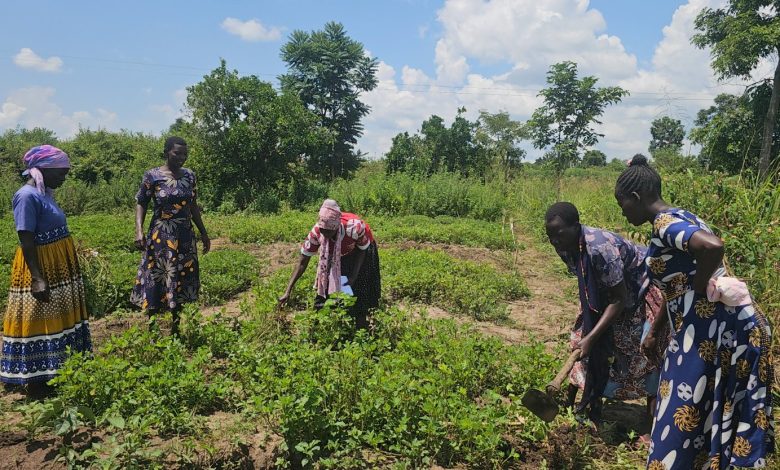
The delegation also visited the Bushiende Agroecology Community School in Mulatse village. Here, host Athieno Jacline showcased kitchen gardens and nursery beds thriving on organic manure. She shared how agroecology has transformed her community.
“Before ESAFF and agroecology came to Bushiende, we were living in low incomes,” Athieno said. “Now we grow different crops and rear animals, which has boosted our incomes.”
Masubo Clair, the school’s vice chairperson, explained that they are teaching other farmers to adopt these practices, showing them how to make organic manure from ash, cow dung, and urine. Their goal is to ensure every household has its own agroecological farm.
Bagaga Ronald, an ESAFF representative, appealed to the farmers to embrace and adopt these practices. He emphasized that by doing so, they can build a sustainable food system for the future.
The visits to St. Thomas Comprehensive College and the Bushiende Agroecology Community School serve as powerful examples of how local, grassroots efforts can be scaled to create widespread change, with youth and community members at the forefront of the agroecology movement.


