
By Our Reporter
SOROTI CITY
A new sweet potato processing facility valued at sh148.5m (USD 40,000) will be built in Kyere town council, Serere district, to support sweet potato farmers in the Teso sub-region in enhancing the commercial value of their crops.
Sweet potato serves as a staple food and a vital income source for the Teso community.
The project will be spearheaded by the Soroti Sweet potato Producers and Processors Association (SOSPPA), with financing from the Global Agriculture and Food Security Program (GAFSP). It will receive technical support from the International Potato Centre (CIP), the Ministry of Agriculture, Animal Industry and Fisheries, and will be overseen by the World Bank.
Joseph Okalebo, the coordinator for SOSPPA, shared that the facility will focus on processing orange-fleshed sweet potato varieties such as Ejumula, Naspot 8, Naspot 10, Naspot 13, Narospot 7, and Tanzania into products including puree, pasta, and spaghetti. This development is poised to secure market access and address the issues surrounding the importation of fresh sweet potato roots.
Sweet potato puree, pasta, and spaghetti are versatile culinary ingredients that enhance nutrition, texture, and flavor in a variety of dishes. Puree can serve as a thickener or base for soups and baked goods, while sweet potato pasta incorporates root vegetables into hearty dough. Sweet Potato spaghetti is a low-carb, gluten-free alternative to conventional noodles.
Currently, Teso sweet potato farmers have been processing their produce on a small scale, often without significant value addition or market access. The new facility is expected to process one tonne of fresh roots into puree every hour, effectively mitigating these challenges.
“We will be processing sweet potato into puree, pasta, and spaghetti, ensuring there is a market for our product, especially since importing fresh roots poses a problem due to its bulk,” said Okalebo.
This announcement was made at the inaugural steering committee meeting for SOSPPA and GAFSP, held at Soroti Hotel on August 14-15, 2026.
The facility will be developed as part of a four-year project aimed at strengthening the production capacity and resilience of smallholder sweet potato producer organizations in Uganda. It is expected to benefit around 20,000 farmers across 100 groups, along with 3,000 schoolchildren in six districts of Teso, namely Serere, Ngora, Amuria, Katakwi, Soroti, and Bukedea.
Before the facility’s establishment, Okalebo emphasized the importance of training farmer groups in agronomic practices, providing access to clean seeds, and boosting production through the introduction of improved orange-fleshed varieties known for their early maturing and drought-resistant properties.
“We will also work with farmers to diversify beyond the monotonous cycle of sweet potato cultivation,” Okalebo noted.
Dr. Fredrick Kobina Ebo Grant, the Uganda country manager and nutrition scientist at the International Potato Centre (CIP), has shared that they expect to establish a new facility by the end of the year, with contractor advertisements set to go out soon.
He emphasized that local farmers will receive training on accessing clean materials and cultivating crops in a climate-smart way, addressing the challenges posed by climate change to ensure a sustainable supply of sweet potatoes.
Dr. Kobina noted that with increased sweet potato production and processing, markets will be accessible not just within Teso, but also in regions like Karamoja and Gulu.
Zebulon Ejomu, a sweet potato farmer from Serere district, expressed enthusiasm for the project, highlighting that farmers have previously struggled with agronomic practices and lacked knowledge in value addition, limiting them to selling sweet potato roots in local markets.
Christine Akello Ekinyu, another farmer, mentioned that their practices have been quite basic. However, with the upcoming training, they will be equipped to sell their products both nationally and internationally after receiving UNBS certification, which she believes will significantly improve their living standards.
SOSPPA, founded in 2006, currently includes over 2,090 farmers in 97 groups across six districts in Teso.
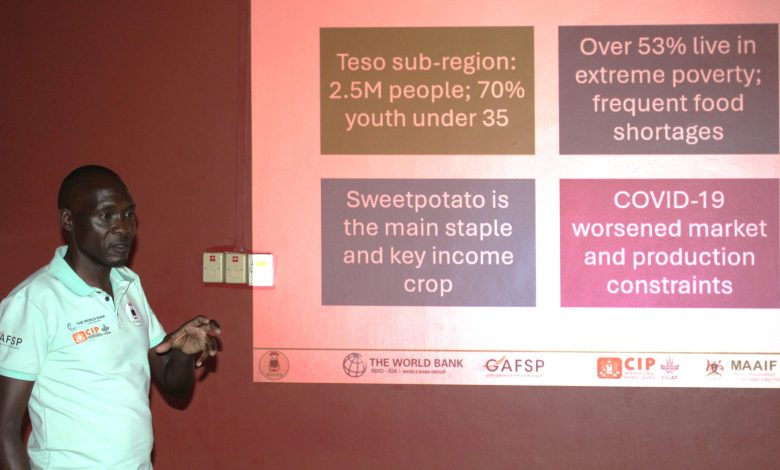
The Teso sub-region, home to approximately 2.5 million people, faces challenges with 70% of the population under 35 years of age and over 53% living in extreme poverty. This situation has been exacerbated by frequent food shortages and the impacts of COVID-19 on market access and production capabilities.


