
By Sadique Bamwita
ENTEBBE
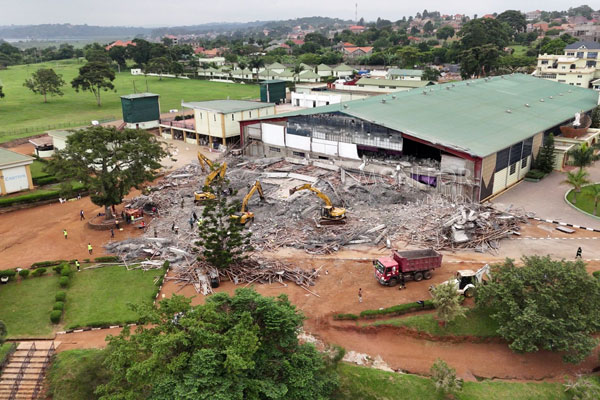
The National Building Review Board (NBRB), has attributed the collapse of a four-storey Extension Facility at Holy City Church in Entebbe, which left two people dead and 25 construction workers severely injured to structural design flaws, poor workmanship and inadequate professional supervision.
In a technical assessment released after an inspection of the site on October 28,2026, the board reported that the building initially tilted before tipping over and eventually collapsing completely. The incident occurred on Monday as workers were undertaking finishing activities on the structure.
The collapsed section was a four-level extension, comprising a ground floor and three upper floors, being added to an existing church hall built with a steel frame. Investigators said the extension was constructed using reinforced concrete integrated into the older structure.
The NBRB classified the project as a Class A building, a category subject to the highest level of regulatory approval and professional oversight because of its structural complexity and capacity requirements.
“Under the building rules, it is a Class A building, which means it requires the highest level of approval and professional oversight,” the board stated.
The preliminary investigation identified possible design deficiencies involving large concrete beams, some measuring approximately 60 centimetres by 60 centimetres and extending more than six metres without intermediate support.According to the board, the dimensions and unsupported spans of the beams raised concerns about whether the structure had been adequately designed to withstand the loads imposed on it.
The board added that its collapse is highly related to possible design problems with very large concrete beams, measuring up to 60 cm by 60 cm, and some stretched more than 6 metres without support,” the statement said.
Further examination of the debris revealed uneven and irregularly shaped columns, beams and floors, which the board said could indicate poor workmanship and inadequate supervision by qualified professionals.
“The columns, beams and floors were uneven and irregular in shape and this suggested poor workmanship and a lack of supervision by a qualified professional,” the NBRB noted.
Inspectors also found irregularities in the steel reinforcement used in the concrete floor slabs. The reinforcement bars reportedly varied in size and were spaced inconsistently, potentially weakening the structural integrity of the floors.
The assessment also raised concerns about compliance with construction-site safety requirements, with inspectors reporting that mandatory safety measures and protective equipment were not observed during their inspection.
Besides, the suspected structural and workmanship defects, the investigation found that the project was being undertaken without the required regulatory documentation.
According to the NBRB, inspectors found no valid building permits, approved structural drawings or other necessary regulatory clearance documents at the site.
The absence of these approvals raises questions about how construction proceeded on a multi-storey project classified as requiring the highest level of regulatory scrutiny.
The board’s findings remain preliminary, and further investigations would be needed to establish the precise sequence of events that caused the building to collapse and determine individual responsibility.
The Building Control Act, 2013, provides for criminal liability where negligence or a failure to comply with legal obligations results in death, injury or property damage at a construction site
Section 45 of the Act addresses offences arising from negligence, acts or omissions connected to construction-related accidents. The provisions cited in the available information include failure to comply with building standards, professional negligence, failure to insure construction workers and undertaking construction without valid permits.
However,depending on the offence and the applicable legal provisions, offenders may face fines, imprisonment or both.


