

By Sadique Bamwita
ENTEBBE
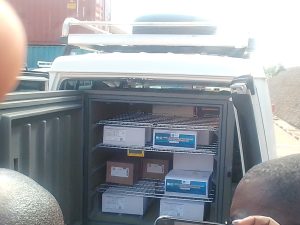
The Minister for Health, Hon. Dr. Jane Ruth Aceng, on April 30, 2025 flagged off twenty (20) refrigerated land cruisers worth 1.6 million USD to ease vaccine accessibility in the districts of Busoga region adding that more eight refrigerated vehicles will be shipped in soon.
Hon. Aceng says that in order to ensure vaccines reach all remote health centers especially Health center three and Health IV, her ministry in partnership with National Medical Stores (NMS) have launched a campaign dubbed as “Pilot for Vaccine Last mile delivery” which is intended to reduce vaccine wastage and to enhance vaccine uptake in remote areas in Busoga region.
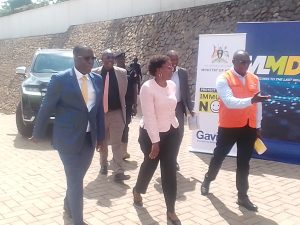
While addressing the gathering at National Medical Stores Head Office in Kajjansi Town Council, Minister Aceng noted that her ministry has started with districts in Busoga region because the region has religious sects which don’t believe in immunization hence leading to a high number of unimmunized children. She added that besides Busoga region, there are other twelve districts which are equally doing poorly across the country and they need to be supported.
“Some areas in Busoga region, the vaccine coverage is low and have a number of unvaccinated children. This is attributed to religious sects that don’t believe in immunization. Therefore, it is very important we support the District Health Officers rather than spending time to collect vaccines. Let’s make the vaccines available at all health facilities so that unimmunized children access the vaccines,” she said.
She says that to make matters worse, Busoga region has some areas with very poor terrain that causes a lot of troubles especially during the rainy season.
She adds that DHOs struggle to get to such hard to areas to supply the vaccines hence a serious tragedy saying it is the reason they decided to begin with Busoga region.
She revealed that the Vaccine last mile delivery is funded by the Government of Uganda and development partners like World Bank, Gavi, UNICEF, Clinton Health Access Initiative (CHAI) and World Health Organization.
Each refrigerated vehicle costs 60,000 USD and the 28 vehicles cost 1.6 million USD. However, it’s not only the vehicles that come but there are other investments in fuel, servicing them to move and the total investment is 2million USD to move and begin actual work.
Minister reiterated that the vaccine last mile delivery program would help to overcome vaccine challenges on top of ensuring equitable immunization services across the country. She added that her ministry had previously received field reports that remote health 111s and IVs face significant challenges in accessing immunization commodities.
“Safety immunization programs are vital for disease prevention and control, and this largely relies on availability and support to human resources and all other immunization supplies, “said Minister Aceng, adding that her Ministry is very aware that the lower level health facilities face huge challenges in accessing immunization challenges. Due to this, we have different vaccines stock out and vaccine wastage occurs which leads to increased zero number of zero doses and under-immunization of children.
‘ Similarly recent effective vaccine management assessments indicate that only 15% of health facilities receive vaccines directly from the district vaccine stores with many relying on unsustainable pick up arrangements due to lack of adequate transport means and lack of prioritization of vaccine distribution by the district leadership.
‘ Therefore, the vaccines last mile distribution campaign aims at ensuring equitable and timely vaccine distribution, directly delivering vaccines to the lower level health center facilities implying health center 111s and IV will receive vaccines directly , reducing stock out and improve vaccine stock availability at all levels of the supply chain and lastly strengthening cold chain management through on job mentorship during vaccines delivery to improve vaccine stock management among the health workers.’
Minister Jane Ruth Aceng also noted that there are major areas that need immediate interventions and the vaccines Last mile intervention is one of the avenues that will greatly help to close these gaps including monitoring, record keeping, achieving and reporting of key performance indicators on site like skills development of personnel who handle vaccines on day today basis including key output which is distribution of vaccines. She, however, noted that there is 5% of the area that is uncovered and that her ministry expects 5000 cold chain refrigerators that are solar powered so as to cover the 5% gap on top of replacing those that are not working or obsolete.
Minister Aceng emphasized that in order to overcome vaccines challenges there is need:
“To ensure that health workers use the available vaccines so as to improve on vaccine uptake and supervision which is definitely weak in some areas adding that there are twelve districts that are poorly performing and their vaccine coverage levels are quite low. We also need to ensure the cold chain systems are well maintained so that when National medical stores deliver vaccines they remain in a good state. This calls for a lot of training, supervision, and monitoring as we celebrate this Last mile delivery, Minister Aceng emphasized.
Minister Jane Ruth Aceng expressed serious concern that available refrigerated vehicles won’t be enough since Uganda has a total of 149 districts and appealed to all development partners at all levels to rescue the situation so as to fill in this gap.
“The acquired refrigerated vans will be deployed to support distribution within the districts and will be managed by National medical stores. So, no district officials or leaders should have plans to hijack those vehicles and transform them into beef ferrying vehicles. They remain the sole property of National medical stores for only vaccines distribution and I’m saying this because we have evidence on what happened to COVID-19 and Gavi pickup trucks. Let’s maintain these vehicles and look after them very well as they do the work they are meant to do, ‘Minister Aceng sounded her warning.
‘It’s my humble appeal that as we embark on this crucial part that we support the team in providing relevant feedback and recommendations towards these improvements. I task NMS together with its development partners to continue collecting this vital information. You should take note this roll out of vaccines will be done in three phases as we pilot and see how it goes on.
‘ I appreciate the district and city health officers for overseeing implementation of health services in the lower local governments. Note, we have fourteen antigens in Uganda that exclude antigens which come with outbreaks like Ebola. Uganda is one of the countries in Africa with the highest number of antigens and this is not a surprise that our life expectancy is over 68years, our children are living longer because when they live longer the women are able to produce few children and men are capable of working harder to look after their women, Minister Aceng observed.
Minister Aceng further challenged Journalists to focus on prevention than treatment in their news items
“The focus should not be on treatment because it’s a bottomless pit. For example if you get malaria today, you can get it in two weeks. This explains why the government can’t supply adequate medicine to the population which is growing at 3% annually. The Ugandan population is very fertile and every year we get over 1.6 million newborn babies. The population of the youth alone as per demographic surveys is about 70% and all these are dependants. So, for any nation that is growing we must emphasize prevention, ‘Minister Aceng challenged journalists.
‘To say there is drug stock out implies that our mindset is still focused on treatment which won’t help. The current ministry of health strategy for the last 5years focuses on prevention –a national community engagement strategy, ‘Minister Aceng revealed. ‘
Dr. Medard Bitekyerezo, the National Medical stores (NMS) board member, said the last mile delivery program will ensure direct and timely delivery of vaccines to health centers hence reducing stock out and wastage of vaccines across the country.
“This initiative will improve life expectancy and quality of life for all Ugandans. Therefore, no Chief Administrative officer or district political leader is expected to move in a vaccines car adding that no Ugandan will be left unimmunized on grounds that the vaccines have not reached them, “Dr. Bitekyerezo warned.
Dr. Bitekyerezo baptized Minister Aceng with a new name of “Kyomugisha” which he says in his culture literally means a woman of luck.
“ Its during your regime that the highest number of children are being immunized , NMS has been able to put up the biggest pharmaceutical warehouse in the country, infant mortality has gone down, Mulago women hospital was opened and above all , the ministry of health entities have been pushed to work hard, ‘Dr. Bitekyerezo explains why the minister deserves the name.
The Jinja City Health officer, Dr. Fredrick Isabirye, said with the acquisition of refrigerated vehicles there will be no more delivery of vaccines on motor bikes and bicycles. He however, informed the minister that they have a problem with the Chief Administrative officers and LC5 chairpersons who hijack such vehicles and personalize them.
“We have been transporting vaccines without specialized vehicles and remember they are prone to temperature sensitivity and most of them must be kept between 2-8 degrees Celsius. Recently, we got double cabin pickups but they came with challenges as top district officials hijacked them and personalized them because they didn’t have official cars.
“In terms of geographical terrain, the acquired vehicles can navigate hard to reach areas. For example in some parts of Buyende district when it rains water flows backwards and cuts off most of the roads but these acquired land cruiser vehicles are really designed for various terrains , ‘Dr. Isabirye appreciated.’
“Most of the districts in Busoga region allocate little money to the DHOs office and it doesn’t exceed Shs 3 million. We have been having small old cold chain fridges in our health facilities yet the numbers of vaccines keep on growing every single day. But with the acquisition of refrigerated vehicles this is now solved and we only need to emphasize supervision and uptake of vaccines.
‘ The small challenge I foresee is refilling the refrigerators, and I don’t think we have enough fleet to do three trips to our health facilities in a month or week as some health facilities are big consumers.
“We also need to take into account allowances of staff who will be moving on the refrigerated vans because by the time they get back from the field they are so hungry and don’t expect them to return to the field the following day on empty stomachs, “Dr. Isabirye expressed grave concern.
Dr. Fredrick Isabirye further appealed to the government to build capacities of cold chain technicians in the districts in areas of maintenance and minor repairs such that the available fridges and other equipment don’t go to waste because they are not used.
The Assistant District Health officer in charge of maternal and child health at Kamuli district, Dr. Moses Lyagaba, reiterated that the refrigerated land cruisers would go a long way to address the cold chain issue which has been a big challenge in the district.


