
By Sadique Bamwita
KAMPALA
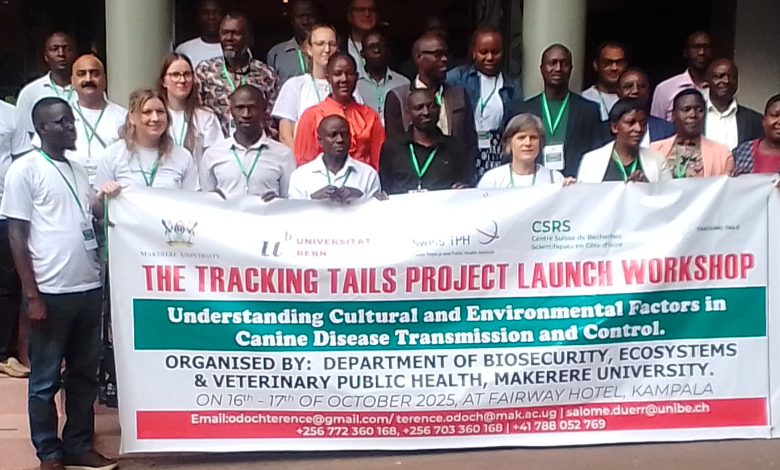
The Department of Biosecurity, Ecosystems and Veterinary Public Health at Makerere University in partnership with Bern University in Switzerland have launched a project dubbed, “Tracking Tails” with the aim of eradicating rabies spread by free roaming dogs in the five selected districts of Uganda.
The five selected districts include Kampala, Masaka, Kyegegwa, Soroti and Arua city.
The Head of the Department of Biosecurity Ecosystems and Veterinary Public Health, Dr. Joseph Kungu, said the five districts were selected based on high prevalence of free roaming dogs that bite locals on daily basis.
Addressing the press in Kampala on October 17, 2025, Dr. Joseph Kungu said the launched project will provide a platform for researchers to conduct research adding that findings will inform police makers on how to develop strategies at the national level so as to eradicate rabies completely by 2030. He revealed that on daily basis they receive 70% cases of dog bites at the national level.
“Dogs and rabies is a very emerging problem in Uganda and globally. As a country we are coming up with ways to prevent and eradicate rabies in the country,” Dr. Kungu revealed.
He says rabies can be eradicated by controlling the dog population, vaccination of dogs and management of dogs by bringing on board communities.
He says communities are the people who live with the dogs both in rural and urban areas. Therefore, there is need to have one health platform to ensure rabies is controlled.
Dr. Terence Odoch, the Principal Investigator at the Department of Biosecurity, Ecosystems and Veterinary Public Health at Makerere University, said the project will help to eliminate cultural practices that associate dog bites to witchcraft. He attributed the Increasing free roaming dogs in the five selected districts of Uganda to irresponsible ownership of dogs.
“We are struggling with to ensure us eliminate rabies in Uganda. Dogs live with us, sleep with us and potentially we can share disease challenges that we acquire as a result of living together with dogs,” he says.
Prof. Dr. Salome Durr, a lecturer at the University of Bern in Switzerland, a partner in the project, noted that most dogs in Uganda are free roaming and can easily spread rabies to humans through dog bites. She however says the best measure to eradicate rabies is to vaccinate at least 70% of the dog population at the national level.
Dr. Haris Tiwari Kumar, a lecturer at India Institute of Technology Guwahati, revealed that his country has 60 million dogs and that 40 % of Indians are bitten by dogs on daily basis. He attributed the surge in dog bites to indiscriminate dog breeding and irresponsible dog ownership.
The Principal Health Officer at the Ministry of Health, Dr. Alfred Wejuri, is optimistic that the project will bring down rabies that form 60% of zoonatic diseases.
“We hope to move together with the investigators. Our staff in the health ministry need capacity building in this field. The data will be a basis to advocate for policy making and funding,” Dr. Wejuri said.


