
By Our Reporter
SOROTI CITY
Soroti University, located in Soroti City, is actively pursuing additional funding of approximately Shs70 billion from the government to enhance its infrastructure, research, and innovation initiatives.
University officials are urging the government to boost their development budget from the current over Shs10 billion. This increase would facilitate the construction of a new central teaching facility, estimated at Shs30 billion, as well as a school of engineering and technology, projected to cost Shs35 billion.
Vice Chancellor Prof. John Robert Ikoja Odongo highlighted that student enrollment has surged from 98 in 2019 to a current total of 949, all pursuing scientific disciplines. He noted that this figure could have been even higher if not for constraints in teaching and learning space, as well as the challenges faced by privately sponsored students, who often struggle with timely fee payments due to financial hardships.
Prof. Ikoja emphasized the critical need for the central teaching facility and school of engineering to be expedited, as these developments would allow for the subsequent implementation of a nuclear engineering project on the 48 acres of land allocated for this purpose.
In a promising development, the university received Shs1 billion from the government’s research and innovation fund for the first time. This funding supports 20 high-impact research projects across various fields, including artificial intelligence, herbal medicine, solid waste management, solar energy, diabetes, high blood pressure, and blood cancer, among others.
However, Prof. Ikoja expressed concern about the limited funding available for the university’s research activities. He is advocating for an increase in the research and innovation fund from Shs1 billion to at least Shs5 billion in the next financial year.
The Vice Chancellor also pointed out that the lack of specialized research laboratories hampers their efforts, forcing staff to conduct research in teaching labs meant for undergraduate skills training. There is an urgent need for dedicated facilities for research in areas such as monoclonal biology, herbal or complementary medicine, artificial intelligence, and environmental chemistry.
Additionally, Prof. Ikoja expressed his gratitude to the government for covering 75 to 80 percent of students’ university fees, and he thanked the Katakwi district local government for generously providing Soroti University with 1,200 acres of land in Palam sub-county. This land will enable the university to engage in community development activities effectively.
Prof. Pius Okong, the third chairperson of the University Council, announced plans for the upcoming academic year that include new undergraduate programs in civil and environmental engineering, mechanical and manufacturing engineering, midwifery, nursing extension, and aviation management. The university is also set to begin graduate studies in public health and has aspirations to develop training in nuclear science.
He expressed a strong desire for increased financial support, particularly to operationalize these new academic programs, enhance academic staff recruitment, and improve infrastructure, specifically the central teaching facility for the School of Engineering and Technology. These initiatives are seen as essential to creating an optimal learning environment.
Prof. Francis Gervase Omaswa, the University Chancellor, shared that the university aims to implement a five-year development strategy from 2025/2026 to 2029/2030. This strategy will focus on infrastructure expansion, including teaching and learning spaces, student and staff accommodations, a center for indigenous knowledge and complementary medicine, upgrading six kilometers of roads, and enhancing the university’s ICT capabilities to align with the National Development Plan 4 and the Sustainable Development Goals (SDGs). Additionally, there will be efforts to review and streamline the curriculum, mobilize resources, and increase research capacity.
He emphasized the importance of addressing key societal issues through research, particularly regarding food harvesting and storage linked to aflatoxin, a known contributor to liver cancer prevalent in the Teso region. Other local health issues, such as testicular hydrocele and sickle cell diseases, also warrant further attention from the university.
Prof. Omaswa urged the government to boost financial support for Soroti University, particularly for infrastructure development, highlighting the need for a central teaching facility and a dedicated School of Engineering and Technology as top priorities, alongside establishing a regional referral and teaching hospital.
He also reported that the university’s performance in the past financial year was commendably at 79 percent. He expressed gratitude for the additional wage budget of 13.8 billion shillings allocated to the university for the 2024/2025 financial year, which has facilitated staff recruitment in critical areas such as engineering and medicine.
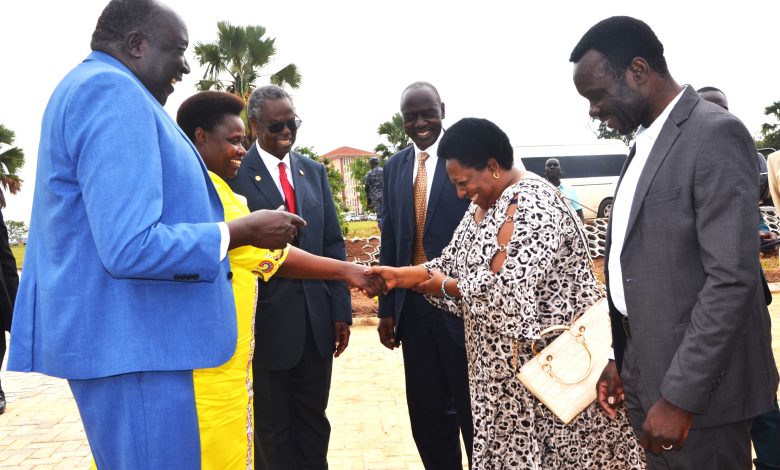
Vice President Jessica Alupo assured that she would relay all the expressed needs to President Museveni, who oversees budget and resource allocations. She emphasized that the president’s plans and programs are in alignment with the National Development Plan (NDP IV) and the NRM Manifesto, which ensures the sustainability of the university.
Established in July 2015 as Uganda’s ninth public university, Soroti University focuses on advancing higher education in applied sciences for regional development and strives to become a hub for innovation and skilled workforce training, while also expanding its health and technology programs since welcoming its first students in 2019.


