
By Delux Emmy Alomu
SERERE

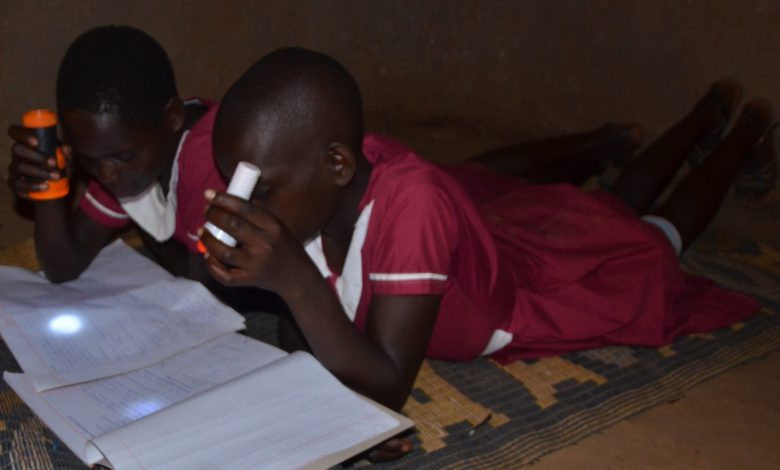
In the rural areas of Serere District, many primary school pupils have taken to using burning grass and small torches for their revisions and homework at night hours.
Families that have a bit more financial means provide their children with small kerosene lamps, known locally as tadooba or Nyangile, which feature a single wick and lack a glass chimney.
These lamps have become a common makeshift solution for lighting in homes that lack electricity, as highlighted by a survey done by East News online.
John Michael Opure, a P.7 pupil at Akumoi Primary School, shared that he relies on the kitchen fire for reading. Similarly, Isaac Osulek, a pupil, mentioned using both small torches and kitchen flames to tackle his homework.
“Sometimes I work on my revisions under the dim glow of a kerosene lamp or amidst the smoke of burning grass. It’s a struggle—I either risk damaging my book or end up with my eyes clouded with weariness. But I push through because there’s no other choice; I want my future to shine brightly,” Osulek shared.
Faith Martha Alupo, a 15-year-old P.7 pupil, noted that the torch she always purchases for 500 shillings only lasts two days, making it a challenge to afford another one.
Parents in Serere, including Marion Akiror, Beatrice Anyipo, Charles Ekidu, and Samuel Eilu, reported that their children often complete homework just before bedtime due to the lack of adequate lighting during the night. Some are forced to use small torches that quickly burn out.
School officials in the district have recognized that insufficient lighting, especially the absence of electricity and solar power, hampers students’ ability to complete homework and prepare for exams, ultimately affecting their academic performance.
Peter Oguti, the deputy headteacher at Ogangai-Kidetok Primary School, which has an enrollment of 1,220 pupils, explained that many parents can’t afford solar solutions, leading some to resort to burning grass or firewood for studying at home.
With the grass also becoming scarce, some children are purchasing torches for 1,000 shillings that last a mere two days before they need replacement.
“Some pupils delay their assignments until morning or work on them just before sunset, and many finish at school during lessons,” Oguti noted.
At Akumoi Primary School, which has an enrollment of 1,109 learners, no pupil has achieved a Division One grade in the last 25 years.
School headteacher Catherine Ipesa attributed this poor performance to a lack of parental support, as many do not invest in even small torches or lamps for their children’s study needs.
Paul Otiiro, headteacher at Odapakol Primary School with 1,562 pupils, echoed similar concerns about learners struggling to secure small torches, kerosene lamps, and glass lamps for their studies. His school hasn’t seen a Division One grade in five years, largely because many children come to school without completing their homework or do it hurriedly in the morning, arriving late.
Kidetok Primary School, which has 1,330 pupils, last achieved a Division One grade in 2023. Headteacher Esther Itaapus Otiira pointed out that certain parents fail to provide necessary study tools like torches, leading pupils to attempt their homework during class time, which distracts from the teaching process and negatively impacts their performance.
“Some parents struggle to provide their children with basic necessities like torches, whether due to negligence or financial constraints,” she stated.
In Uganda, electricity access poses a significant hurdle. According to the 2024 National Population and Housing Census, merely 25.3% of households are connected to the national grid. The situation is even more challenging in Teso and Lango, where grid access dips to as low as 5%.
While solar energy use is on the rise, it remains limited, with only 12.6% of households in Teso and 23.8% in Lango having access. Beneath these statistics are countless children whose education is disrupted each evening when darkness sets in.
In response to this pressing issue, Partners for Children Worldwide (PfCW), in collaboration with Childfund International and Econic Earth USA, launched the WattsOn project on Wednesday, February 25th, 2026.
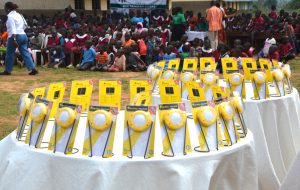
This initiative provided 1,100 upper primary pupils from four schools in Serere with free solar lamps, valued at a total of shs18 million.
The event, held at Akumoi Primary School in Kidetok town council, allowed P.5-P.7 learners from Ogangai-Kidetok, Akumoi, Kidetok, and Odapakol primary schools to walk home with solar lamps designed for safe reading.
George Masuba, the programs manager for PfCW based in Soroti, explained that this pilot project in Serere aims to be expanded into other Teso districts with support from various donors, given the region’s low literacy and numeracy rates.
“Our goal is to move away from using unsafe small kerosene lamps for reading and to enhance the time pupils can engage with learning materials to ultimately improve educational outcomes in the Teso subregion,” he emphasized.
Masuba pointed out that many rural schools lack electricity, making it impossible for pupils to read after dark. Consequently, some rely on kerosene, which poses health risks and environmental hazards.
These lamps offer six hours of light and can be rechargeble for an additional 2-3 hours the following day, enabling children to study at home. This, he hopes, will lead to better performance during the final Primary Leaving Examination (PLE).
Jenner Kanalo, who represented Child Fund Uganda’s country director, Titus Tumusiime, highlighted the critical need for this initiative.
With pupil-to-classroom ratios soaring between 79:1 and over 100:1 in Eastern and Northern Uganda, children must often supplement their learning with self-study at home. However, without adequate lighting, this opportunity is severely restricted.
Kanalo expressed their vision behind this initiative, grounded in the belief that every child, regardless of their circumstances, deserves the light of knowledge to learn, dream, and achieve success.
Watson Nicole, the Chief Executive Officer and founder of Econic Earth, shared that among the 15,000 learners in Africa who have benefited from their WattsOn project over the last five years, many have shown remarkable improvement.
They anticipate that over 2,200 Ugandans who received solar lamps will utilize them effectively, as this pilot project will play a crucial role in determining how to extend support to other regions of the country.
Nicole emphasized that Econic Earth plans to monitor the pupils for more than a year, focusing on their educational performance and the changes occurring in their homes.
Gideon Odongo, the acting Serere District Education Officer, noted that this initiative will alleviate some challenges in enhancing pupils’ performance. In 2025, only 126 P.7 candidates in the district’s 98 government-aided primary schools achieved Division One.
John Stephen Ekoom, the Serere Resident District Commissioner, praised the partners for supplementing government efforts and committed to ensuring the solar lamps are well-protected to fulfill their intended purpose.
Stephen Omwony Lakwonyero, the Deputy Chief Administrative Officer, remarked on their progress in educational performance since 2021, despite challenges such as limited learning materials, staffing shortages, insufficient facilities, and pupils’ absenteeism.
“Let’s ensure these lamps aren’t misused in drinking establishments; they should empower our children and enhance their academic success,” he stressed.
Clare Aisu, a primary six pupil representing her schoolmates of Akumoi P/S, conveyed the struggles they faced due to inadequate lighting and assured partners that their situation will improve with the introduction of the solar lamps.
In the Lango sub-region, four selected primary schools in Dokolo district also received a total of 1,100 solar lamps, serving as a beacon of hope, equity, and a shared commitment to tackling energy poverty as a significant barrier to educational access.


