
By Our Reporter
KATAKWI
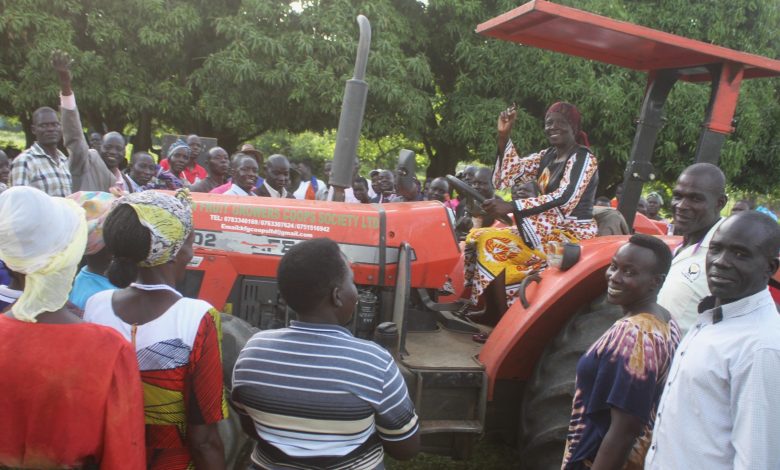
Poverty levels among over 1,000 members of the Kapujan Fruit Growers Cooperative Society in Katakwi District are projected to decline by 70% following the government’s official handover of a tractor valued at shs226 million to the society.
This announcement was made during the cooperative’s seventh Annual General Meeting since its inception in 2012 held at Kapujan Sub County headquarters on Monday March 30th, 2026.
The Kapujan Fruit Growers Cooperative was one of three societies in Katakwi District to receive a tractor from the Microfinance Support Centre through the Local Economic Growth Support Program (LEGS) on March 12, 2025.
According to society officials, of the shs120 million they are required to repay—representing 40% of the total cost—the society has successfully returned shs25 million so far, contributing shs11 million quarterly.
Officials from the cooperative report that the tractor, equipped with essential components such as a planter, trailer, and discs, has allowed them to cultivate over 350 acres of land during this rainy season alone, with the capability of opening 8-10 acres each day. This significant advancement supports the transition to commercial and mechanized agriculture.
John Peter Amanet, the cooperative’s manager, noted that tasks that previously took farmers three days to complete can now be accomplished in just one hour with the tractor.
This enhancement in efficiency has positively impacted the farmers’ livelihoods, with some able to construct permanent houses within a year.
“Already we have testimonies from some farmers who have managed to improve in their commercial agriculture and constructed permanent houses. This tractor is good because it will improve the society’s income rather than depending on annual subscribtion, shares and membership registration moneys,” Amanet said.
Amanet emphasized the tractor’s advantages even before its official handover, highlighting its role in opening up large areas of virgin land and capitalizing on rainy seasons, ultimately contributing to the society’s economic development and unity.
“Katakwi as one of the districts with formerly internally displaced people due to Karamojong raiders, there is vast virgin land that the oxplough or hand hoe cannt open, these tractors are very vital for this areas,” he said.
According to him, the poverty levels will reduce by 70 percent in the next three years especially after they have cleared the remaining loan for the tractor.
He urged the government to provide more tractors to cooperative societies or allocate one to each sub-county to alleviate the struggle for the limited machines currently available.
John Bosco Akubu, a member of the Akisim Ngariam Cooperative Society in Ngariam Sub County, echoed the call for continued tractor distribution to farmer groups, arguing that commercial agriculture cannot thrive when reliant on oxploughs or hand hoes.
Akubu who doubles as the LCV Councilor for Ngariam sub county added that tractors can efficiently cultivate extensive areas for multiple farmers in one day, ensuring timely planting before the onset of dry seasons.
Joseph Omoket, chairperson of the Kapujan Fruit Growers Cooperative Society, shared that the new tractor has enabled them to achieve bumper harvests and has sparked interest in acquiring value-added machines for cassava and sweet potatoes valued at shs900 million.
Bosco Erepun, the commercial officer for Katakwi District, encouraged cooperative societies to think strategically about diversifying their income sources while minimizing expenditures.
During the handover of the tractor, Marion Atim, the district councilor for Kapujan sub county, represented Vice President Jessica Alupo as the chief guest.
She encouraged farmers to join cooperatives, highlighting that Teso has a rich history of utilizing cooperatives for development.
Atim also praised the Vice President for her efforts in securing the tractor and urged the farmers to maximize its potential for their benefit.
According to the 2024 census-based reports, while some income indicators show improvement, over 7 million Ugandans (roughly 16–27% depending on the metric) still live below the poverty line.


