
By Kirinya Ayubu
MBALE CITY
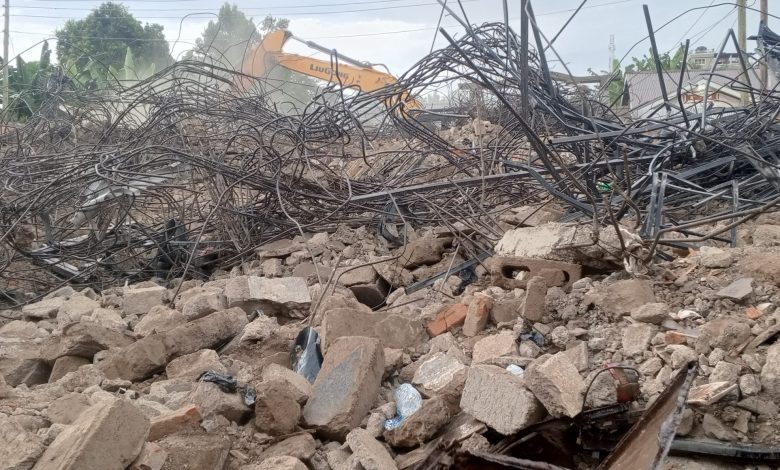
At 2:00 a.m. on Saturday, 2nd May, 2026, the laws of physics finally caught up with the culture of shortcuts in Mbale City.
A five-storey building in Kachumbala Cell, Namakwekwe Ward in Mbale City didn’t just fall; it surrendered. The collapse claimed the life of 37-year-old foreman, Andrew Wonyakala and sent three others to the hospital. The building also leveled two neighboring homes, leaving families to scavenge through the ruins of their lives.
But as the dust settles, the tragedy is revealing itself to be a three-fold failure: a technical disaster, a regulatory vacuum, and a moral bankruptcy that flourished in the shadow of authority.
From an engineering standpoint, the building was a “death trap in slow motion.” While the city reaches for “City Status” with a vertical construction boom, the technical integrity of these new towers is often a mirage.
Experts have attributed the tragedy to a combination of factors including use of substandard and counterfeit materials, poor or no supervision from the council authorities, the weak enforcement of the building regulations and the corruption that comes with the approval of building plans.
Engineer Dan Mukwana, a private engineer within Mbale City says the city council authorities have failed to do their job. He notes that the city engineer who is supposed to conduct supervision and ensure the approved plan is followed and implemented seems to have abdicated his duty when it came to the collapsed building.
According to Engineer Mukwana, Preliminary forensic looks at the debris tell a story of fatal math.
Engineer Mukwana and another engineer who were at the site at time of the incident noted with concern why one would use the T12 (12mm) reinforcement bars in primary load-bearing, columns steel designed for domestic bungalows, not five-storey concrete giants.
They both aver that the materials used were substandard which could have led to the collapse of the building. They said instead of the T12 bars, it would have been prudent if T16 steel bars were used in the construction of such a building.
“You cannot defy gravity with ‘copy-paste’ engineering,” they said at the aftermath of the tragedy.
“They cast heavy, solid concrete slabs adding tons of ‘dead load’ onto columns that lacked the tensile strength to hold them. When the weight reached a tipping point, the building didn’t lean; it pancaked.” They added.
The most damning indictment is geography. For months, city officials would have had a front-row seat to the construction. The Northern Division headquarters are barely 100 meters away from the collapsed building.
Robert Kisesi is the speaker of Northern City Division Council. He wonders if the Engineer in charge of the Division ever inspected the building from the time construction started.
He says “the Division or the city council is to blame for the negligence noting that there is no way such a building would be erected in the middle of the city without the supervision and inspection of the council”.
Under the Building Control Act, construction is a choreographed dance of safety sign-offs. There are mandatory “interruption points” where inspectors must verify the foundation and the steel reinforcement before a single drop of concrete is poured.
The “Paper Trail” however suggests a catastrophic breakdown in this chain. If inspections happened, how did they miss the thin iron bars visible to the naked eye at the site? If they didn’t happen, why was the site allowed to operate for more than five months in the direct line of sight of the Town Clerk and the City Engineer? The collapse suggests a “regulatory gap” where permits are bought, but safety is never sold.
Kazibwe John, a resident of Mbale City wants the Mbale City physical planner and the Engineer to be held culpable. He said the incident should be a wakeup call to the responsible authorities to ensure that future similar incidents are avoided.
“The engineer, the physical planner should come out and tell the public why this building collapsed, they do not carry out supervision but keep on clearing developers to continue with construction,” he said.
Behind the official silence is a trail of human warnings. One of the masons who talked on condition of anonymity, claims the disaster was predictable noting that they raised red flags because of the materials they were using on the construction site.
“We told the boss the columns were too thin. We told him the concrete was still wet, but he told us to keep pouring,” he said, adding “our pleas were ignored”.
This testimony bridges the gap between the technical and the administrative wings of the city. It suggests that the “Paper Trail” wasn’t just neglected; it was bypassed by an informal economy of “facilitation fees” that prioritizes speed over survival.
Mbale City’s Public Relations Officer, James Kutosi collaborates this claim when he confirmed to journalists on Monday during a press briefing that there was no approved plan on the collapsed building.
“I have just told you that there was no approval of plans for that building and if there are no approved plans then there is no way a city engineer can go supervising that work, until, unless otherwise we have been lied to and the plans were approved that’s when we can find the engineer culpable,” he said.
Kutosi avers that the council has since instituted an investigation into the matter to establish the circumstances surrounding the collapse of the building.
“The council has instituted an urgent and independent investigation into the circumstances surrounding this collapse to establish the cause of the incident, determine whether there was any breach of approved building standards, regulatory requirements or dereliction of duty by any responsible persons or offices,” he said.
According to the Building ACT, 2026 as amended, a person who intends to carry out a building operation shall apply to the Building Committee in the area in which he or she intends to carry out the building operation, for a building permit.
The application for a building permit according to the ACT shall be in a form prescribed by the Board, and shall contain the name and physical and postal address of the applicant, be accompanied by the land title or other proof of ownership of the land and where the applicant is not the owner of the land on which the building operation is to be carried out, contain the name of the landowner, the land title or other proof of ownership of the land and a statement of the legal relationship between the applicant and the landowner.
The act further requires that the application form contain the name, registration number and a copy of the practising certificate of the architect and his or her signature, and official stamp of the Uganda Society of Architects and in the case of an engineer, a certificate of good structural practice which shall be accompanied by such number of copies of building plans and other documents as may be required by regulations and also contain a letter from the Chairperson of the Village Council of the area in which the building operation is to be carried out.
As the Uganda Police Force hunts for the developer and the site engineer, the families in the neighboring crushed houses are left with a terrifying reality: in a rapidly growing Mbale, your life is only as safe as the integrity of the man building next to you.
Asked if the law was followed to the dot, James Kutosi told journalists that this formed the basis of setting up an investigation committee which he said those are some of the terms of reference which the committee would follow.
“That is why this committee was formed” he said adding that by Friday the report of the committee will be out for the public.
The Kachumbala house collapse is a “stress test” that Mbale City failed. It exposes a skyline built on a foundation of “paper approvals” and substandard steel. Until the city enforces its own codes with the same weight as the concrete it pours, the rising towers in Mbale City will remain a gamble one where the house, eventually, always loses.


