
By Delux Emmy Alomu
SOROTI CITY
The much-anticipated groundbreaking ceremony for the expansion of the Soroti Fruit Factory has finally taken place, with an investment of $21 million (approximately Sh77.57b).
During the event on July 20th, 2026, Felix Angeki, the factory’s Quality Assurance Manager, shared that the cost of construction (civil works) is pegged at $10 million (approximately Sh37.05 billion), while the machinery procurement will amount to $11 million (around Sh40.8 billion).
Led by Chimaki Agro Limited, the factory’s management company, the construction project is slated to last for ten months, running until June 2027. The build will be undertaken by the China Construction Management Engineering Company. Angeki stated that this new facility aims to produce high-quality juice that can compete on a global scale.
“Today, we are starting construction to stay on schedule, as the machinery is already being manufactured in Italy, with expected delivery by December 2026,” he noted.
The expansion will feature a multi-food processing line and an enhanced automated bottling line, which will increase output from 200 cartons per hour to 800. Additionally, fruit processing capacity will expand from just two types—orange and mangoes at 6 tons per hour—to a versatile system capable of processing six tons per hour for each of five fruit varieties: mangoes, pineapples, passion fruits, ginger, and tamarinds. Before this, the factory was limited to producing Washington Navel, Valencia, and Hamlin Orange species along with local mangoes. In addition to juices and multi-food processing, the facility will also include a bottling line for Teju water.
“These advancements will involve equipment of the highest global standards, ensuring top-notch fruit quality and safety,” he added.
Angeki reassured farmers that the factory will not be purchasing fruits from now until June next year, allowing time to complete the expansion fully.
Aside from the groundbreaking, the management company plans to create value from generated waste by producing fertilizers and animal feeds, as well as establishing tissue culture production to provide high-quality seedlings of oranges and mangoes for farmers.
Bob Owiny, speaking on behalf of district chairpersons from the Teso sub-region and the Soroti District LCV Chairperson, welcomed the expansion, noting that it would enable the factory to process more fruit varieties. However, he expressed concern that farmers would lack a market for their fruits during the construction period.
He urged more investors to consider setting up factories in Arapai Industrial Park, particularly for coffee, cocoa, and banana processing.
Some farmers are thrilled about the expansion of the fruit processing factory, hoping it will lead to greater demand for their produce, job creation, and increased local revenue. However, there are concerns about how they will support themselves during the upcoming 10-month period when the factory will not be purchasing fruits.
Robert Ogalo, leader of the Orupe fruit growers’ group in Ocaapa town council of Serere district, expressed disappointment over the pause in fruit processing. He wishes the factory could continue processing some fruits instead of shutting down entirely until the expansion is complete.
Emmanuel Esabu, another farmer, urged the government to provide them with a variety of seedlings and establish demonstration gardens, especially now that the expansion has been initiated.
Catherine Adongo, a farmer from Oburin cell in Ocaapa-Serere who started citrus farming in 2006 and now manages over 2,000 fruit trees, is eager for increased tonnage to be accepted from farmers during the expansion.
She is also concerned about where their oranges will go in the interim, as many have relied on supplying them for their livelihoods.
The farmers collectively appealed to both the factory management and the government to find alternatives for current fruits to maintain a strong relationship with them.
John Baptist Amega, an agricultural officer in Kumi District, advised farmers to stay patient through this season when they won’t be supplying the factory, assuring them that once the expansion is completed, they will be able to supply again next season.
During the groundbreaking ceremony, Chief Guest John Michael Okurut, the Soroti Resident City Commissioner, encouraged the factory management to seek out more mini-partners from districts across the region to enhance the marketing of oranges.
He reaffirmed the government’s commitment to the expansion of the fruit factory while cautioning that expired leases within the industrial park would be revoked.
“I want to inform the people of Teso that the City and Soroti district leadership are going to review all the allocations for the industrial park. Those leases that are found to be expired will be canceled, and we will invite more serious investors,” Okurut stated.
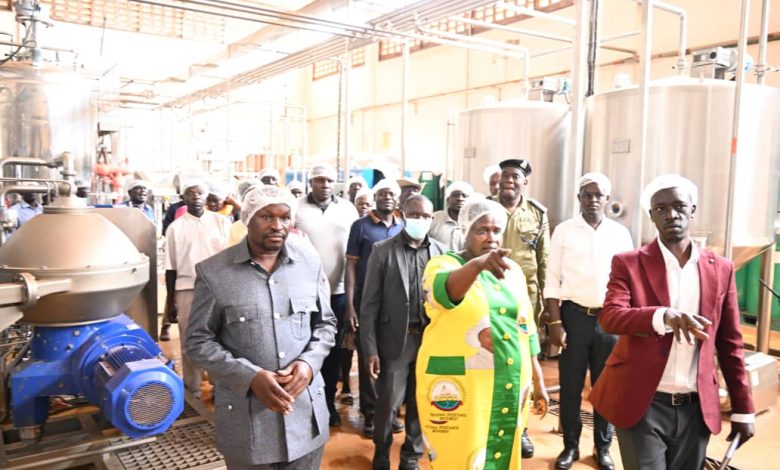
The groundbreaking ceremony saw attendance from district chairpersons across Teso, top officials from the Soroti fruit factory, and local farmers.
Construction of the Soroti Fruit Factory began under the initiation of President Yoweri Museveni in September 2014, with commercial operations officially starting on April 13, 2019.
Located in the Arapai Industrial Park of Soroti City, the facility produces “Teju” brand ready-to-drink mango and orange juices, aiming to reduce post-harvest losses in the Teso subregion.


