
By Aaron Okotel
MBALE CITY
Farmers in the Elgon sub-region have raised concern over the widespread circulation of counterfeit agro-inputs, warning that fake seeds and chemicals are undermining oilseed production and frustrating government efforts to improve agricultural productivity.
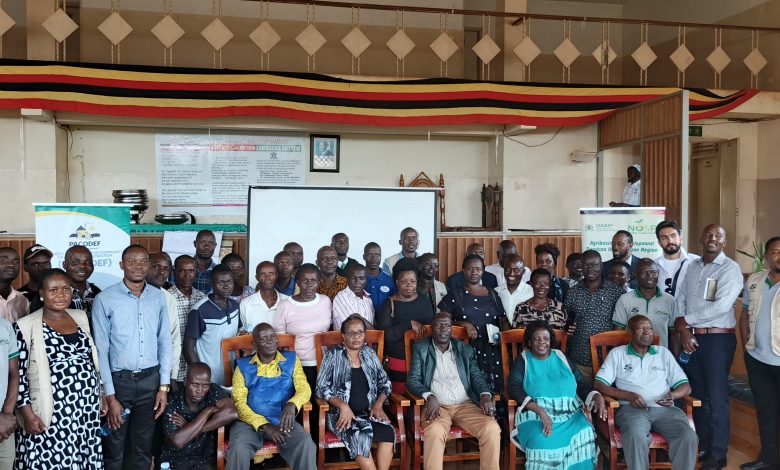
The concerns were raised during a multi-stakeholder engagement on the National Oil Seeds Project (NOSP), an initiative of the Ministry of Agriculture, Animal Industry and Fisheries (MAAIF), organized by the Poverty Alleviation and Community Development Foundation (PACODEF).
The meeting held on Thursday, 6th August, 2026 in Mbale city brought together farmers, agro-input dealers, financial institutions, insurance companies, seed producers, researchers, mechanization service providers and agro-processors to identify solutions to challenges affecting the oilseed value chain while strengthening market linkages for farmers.
Representing Bukola Chemical Industries, Mbale Branch Manager, Augustine Mafabi described counterfeit agricultural inputs as one of the biggest threats facing farmers.
“Everything in Uganda today comes from the farmer. The biggest challenge in the agricultural ecosystem is fake chemicals, fake seeds and substandard agricultural inputs,” Mafabi said.
Paul Osia, a Research Associate at the National Semi-Arid Resources Research Institute in Serere District under the National Agricultural Research Organisation (NARO), said the country has already developed high-yielding oilseed varieties but lacks sufficient funding for large-scale seed multiplication.
“The government should increase funding for seed production. We are conducting demonstration gardens across the country to expose farmers to these technologies, but we now need massive seed multiplication so farmers can access enough quality seed,” Osia said.
He explained that adequate seed supplies would enable farmers to expand production, improve yields and participate in value addition.
“With increased seed funding, farmers will be able to cultivate at least one acre using high-yielding varieties released by NARO. This will increase production and provide enough grain for markets and processing,” he noted.
Moses Mitala, Executive Director of NECOFARM, a harvest and marketing company, welcomed the implementation of the National Oil Seeds Project but said farmers continue to face shortages of improved seed and limited access to reliable markets.
“We appreciate the Ministry through PACODEF for bringing the oilseed project. However, there is still a shortage of improved seed varieties. We also request increased farmer education on proper production practices and expansion of markets for farmers’ produce,” Mitala said.
Augustine Mafabi further urged the Ministry of Agriculture to expand similar interventions beyond oilseed crops.
“Let this programme not be limited to oilseeds only. It should also cover other major crops grown in this region so that more farmers can learn how to identify genuine seed and appropriate farm inputs,” he added.
PACODEF’s Elgon Regional Coordinator, Peter Ababere, urged farmers to organize themselves into cooperatives to improve their bargaining power and eliminate middlemen dealing in counterfeit products.
“We want farmers to buy directly from major agro-input dealers. Since not every farmer can travel long distances, cooperatives should establish agro-input shops where members can access genuine seed, pesticides and herbicides closer to home,” Ababere said.
He also recommended that every cooperative employ an agronomist to provide technical support and promote good agronomic practices, saying this would improve productivity while reducing farmers’ dependence on unqualified input dealers.


