
By Mike Rwothomio
ZOMBO
Paidha is a bustling town council in Zombo District, West Nile, with a population of over 40,000 people, according to the 2024 statistics by the Uganda National Bureau of Standards, and 45 villages or cells.
The town, which borders eastern Democratic Republic of Congo (DRC), has experienced rapid population growth and urbanisation over the past 20 years, accompanied by expansion in infrastructure and social amenities.
While the development of Paidha is viewed positively, some leaders and stakeholders are concerned about its environmental consequences, warning that emerging challenges need to be addressed before they get out of hand.
About 10 years ago, structures within the inner ring of the central business district were few, as were those in neighboring areas. Most of the land was occupied by indigenous people of Paidha clans, including Jupanyondu, Jupandika and Jupagatha, many of whom lived in traditional grass-thatched huts scattered across the town.
However, as development expanded, many indigenous residents sold large portions of their land to wealthy businessmen, mostly from eastern DRC.
Many of these businessmen sought refuge in Uganda because they felt unsafe in DRC due to prevailing insecurity, while Uganda offered peace and tranquility.
The investors subsequently constructed elaborate and expansive buildings across the town, some of which are now located 20, 30 and 40 metres from wetlands, in disregard of the Physical Planning Act, 2010.
Building within protected zones without the required permit can result in demolition by authorities without compensation, heavy fines or imprisonment under Uganda’s Building Regulations.
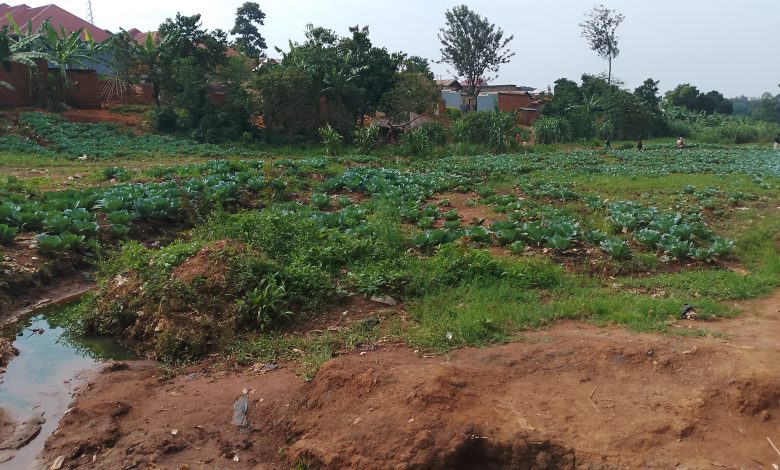
At the centre of these environmental concerns is the Solia wetland and valley, which stretches for several kilometres.
The Solia valley is a critical geographical feature dividing Mission and Solia cells and carries water from the upper part of the town down to the Nyibola stream on the Uganda-DRC border.
As construction continues in both Solia and Mission village cells along the valley, waste generated from buildings and households is increasingly being channelled directly into the Solia water system.
The practice is contributing to environmental degradation through the destruction of natural water filtration systems, increased flood risks, pollution and contamination of aquatic ecosystems.
Over the weekend, this publication witnessed evidence of waste from homes being directed through artificially created channels running deep into the Solia streams.
A woman from Solia cell, carrying a baby on her back, was seen dumping solid waste packed in a Kaveera into a channel created to direct wastewater from a bathing shelter into the stream.
The incident, which occurred in broad daylight, adds to the growing environmental crisis affecting Solia, a major valley within Paidha Town Council.
Dumping waste and redirecting wastewater into wetlands and water channels is prohibited under Uganda’s environmental laws and regulations. The National Environment Management Authority (NEMA) regulations provide for the protection of wetlands, riverbanks and lakeshores, while dumping construction waste in designated wetlands is illegal and may attract heavy fines, demolition of structures or imprisonment.
However, to many residents, the practice remains business as usual, partly because the town council lacks adequate enforcement personnel.
The continued degradation and waste disposal in the Solia stream has now attracted the attention of authorities in Paidha Town Council, Zombo District, who have raised concern over the rampant construction of buildings and the deliberate diversion of waste channels into the Solia valley’s water system.
Fred Ukende, Forestry Officer for Paidha and Padea town councils and Abanga and Paidha sub-counties in Zombo District, has cautioned residents, saying the area is being closely monitored.
“There is one place called Solia valley, people are constructing anyhow and redirecting wastes from buildings, bathing shelters, utensils amongst others. It is in total disregard of the Public Health Act,” Ukende said.
Uganda’s environmental laws prohibit draining, encroaching on or polluting wetlands, which are recognised as vital and protected natural ecosystems held in trust for the public. The principal legislation governing their protection is the National Environment Act, supported by the Constitution of Uganda, 1995, and specific wetland regulations.
While addressing property owners in Paidha Town Council during a recent engagement meeting, Ukende said the government was closely monitoring developments along the Solia valley.
“The government is seriously monitoring what is happening along Solia valley and serious action will be taken,” Ukende said.
The Environmental Impact Assessment (EIA) requirement also provides that before a developer undertakes activities close to sensitive ecosystems such as valleys or wetlands, an assessment should establish that the project will not cause downstream flooding or environmental degradation.
The government this year unveiled the National Wetland Strategic Plan 2026–2036, reinforcing its commitment to wetland conservation amid growing threats from encroachment, degradation and climate change.
Under Uganda’s National Environment Act, 2019, and National Environment Regulations, reclaiming, draining or damaging wetlands is prohibited. Offenders face severe penalties, including fines of up to UGX 600 million, imprisonment of up to 12 years, or both, alongside possible community conservation obligations.
In Zombo District, many wetlands under customary land ownership face degradation and possible extinction due to human activities, including construction and poor farming practices.
Paidha Town Council, which has 45 villages or cells, has witnessed similar practices, particularly construction along wetlands and drainage systems in areas including Solia, Anyong, Zingili and Anjat.
This is happening as the town prepares for the proposed implementation of its Physical Development Plan 2025–2035.
The Physical Planning Act, 2010, establishes the legal framework for land-use management and spatial planning. It creates the National Physical Planning Board and local planning committees to regulate orderly and sustainable development at national, regional and local levels.
Paidha Town Council Physical Planner Anthony Ubedgiu urged communities to desist from the practice, citing the Public Health Act, which prohibits activities that create public health hazards.
He added that under Uganda’s Public Health Act (Cap. 310), polluting public water bodies is illegal and local councils are legally mandated to prosecute people who create such health risks.
Meanwhile, Alur King, His Majesty Ubimu Philliph Rauni Olarker III, in his April this year’s pronouncement, reaffirmed the Kingdom’s support for government wetland conservation policies and sustainable environmental management.
The King expressed concern over continued wetland degradation through pollution, unsustainable farming practices, deforestation, charcoal burning and other destructive activities, saying they contravene national environmental policy and threaten critical ecosystem services.
In a message from His Royal Majesty Phillip Olarker Rauni III, delivered by the Kingdom Prime Minister, Prince Lawrence Opar Angala, in April 2026, the King emphasised the urgent need for community-led wetland management, integration of indigenous traditional knowledge into environmental planning and comprehensive public education on sustainable wetland use.
“His Majesty Ubimu has come out with a pronouncement on wetlands because it is one of the most valuable ecosystem on our planet, so Ubimu says our traditional knowledge system should help us to responsibly farm, fish and manage water and live in harmony with our environment,” Ubimu said in his series of pronouncements read by the Kingdom Prime Minister (Jadipu), Prince Lawrence Opar Angala.
According to the national status report on wetlands in Uganda, over the past 25 years, the Eastern Region has experienced the highest rate of wetland degradation at 46 percent, followed by the Central Region at 29 percent, Western Region at 28 percent and Northern Uganda at 21 percent.
The King reminded his subjects of the importance of environmental conservation, saying:
“We should take the conservation of our environment very important, our natural environment in the Kingdom including DR Congo are facing pollution, unplanned development, and sustainable use.
The leaders’ call for wetland preservation aligns with the government’s continuing efforts to address the high rate of wetland degradation across the country.
Environmental experts have largely attributed rapid wetland degradation across Uganda to population growth, conversion of wetlands for development and urbanisation, as well as weak enforcement of existing environmental laws and wetland policies at regional levels.
President Museveni has recently directed all wetland encroachers to vacate peacefully, declaring an amnesty while reinforcing protection for Uganda’s 8,613 wetlands.
The directive prohibits farming, particularly rice cultivation, and construction in wetlands while encouraging alternative livelihoods such as fish farming on the periphery. The initiative aims to increase wetland coverage from 9.3 percent to 11 percent by 2036.
Daniel Pikisa, Executive Director of Colein Aid, a non-governmental organisation in Zombo, said in a recent interview that the organization is supporting wetland conservation through its “Access to Land Justice” project. The project focuses on planting native tree species along River Ora to mitigate climate injustice and address the rampant depletion and degradation of the river.
In 1994, Uganda’s wetland cover stood at 15 percent but declined to 8.9 percent by 2024. However, intensified government restoration efforts saw wetland coverage recover from 8.9 percent to 9.3 percent by 2025.
This year’s World Wetlands Day was marked under the theme, “Wetlands and Traditional Knowledge: Celebrating Cultural Heritage.”
Cultural and traditional leaders were encouraged by the government to participate in wetland conservation because of their direct links with communities whose activities contribute to wetland degradation.


