
By Sadique Bamwita
ENTEBBE
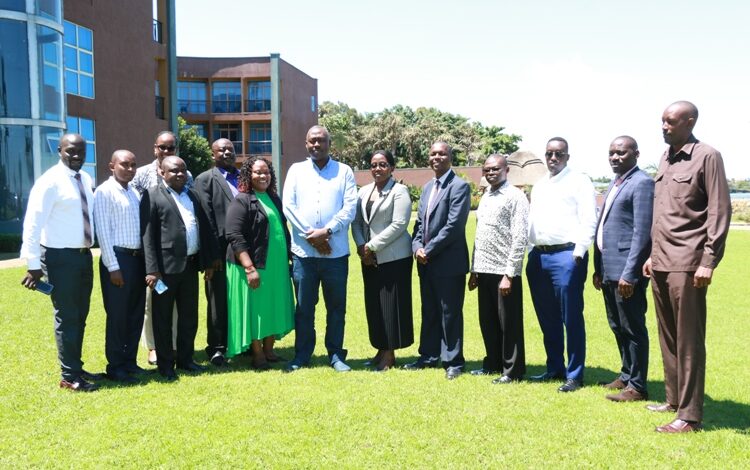
Stakeholders under their umbrella body East African Kiswahili Commission met in Entebbe on April 11, 2024, to discuss the strategy that can help to popularize the usage of Kiswahili language at local, national and regional level.
The Secretary General of East African Kiswahili commission, Dr. Caroline Asiimwe said despite engaging line ministries like the Ministry of East African affairs and inter-religious council, a lot of effort is needed to change the negative attitude among people who associate the language with barbaric armed forces and criminals.
She made the comments in Entebbe while meeting Kiswahili language policy stakeholders from member states within the East African Community.
Dr. Caroline Asiimwe said for member states to realize their dream of making Kiswahili an official language, there is need to develop capacity intervention programs plus strategic guidelines on how the language is supposed to be used. She urged all member states to come up with Kiswahili council as an implementing body organ.
“We need to develop Kiswahili as our official language because we have had English as the official language for many years but unfortunately it has had no impact. Each partner state is required to have a Kiswahili council to develop Kiswahili language. Some people think colonial languages are prestigious.
Dr. Asiimwe noted though there is political will among partner states to embrace Kiswahili as an official language, implementation may be difficult due to lack of clear language policy and that to make matters worse, some member states have different capacity levels which may be challenge for other member states to match the same level.
“As the East African Kiswahili Commission we are ready to conduct training for teachers. Most of the funding is in hard power but no soft power. We need healthy communication to sensitize the masses on trade tariffs and barriers for those doing business across borders.
The Head of the Department of Humanity and Kiswahili education at Makerere University, Dr. Levi Masereka, revealed that Makerere University has been at the forefront of developing Kiswahili language adding that the university developed an innovation fund to fund the development of Kiswahili language.
“We have come up with a program to improve the youth vocational skills. The University also offers introductory courses to students. A few years ago, the university sponsored its staff for PHD studies. Apparently the attitude towards Kiswahili language is positive as compared to before. Kiswahili is abantu language and we are looking at developing it using our local languages,” Dr. Maseruka revealed.
Dr. Maseruku noted that though universities have been able to produce over 2000 Kiswahili teachers, majority are still unemployed. He however called on the government to recruit the unemployed Kiswahili teachers and also to begin teaching Kiswahili starting from primary to secondary level.
“Kiswahili enrolment has increased at the University level and over 2,000 students have graduated in Kiswahili language. We urge the government to recruit teachers who have graduated in Kiswahili language, “Dr. Maseruka made the appeal.
Dr. Aida Mutenyu, the chairperson for Kiswahili lecturers and also Kiswahili lecturer at Kabale University, said she is impressed with the growing number of students pursuing Kiswahili at higher institutions of learning.
Mr. Edwin Nyachwara, one of the stakeholders of Kiswahili language , expresses concern on the limited number of media personnel to spearhead the Kiswahili program and called on the government to train media personnel in Kiswahili language.
“We need to strengthen the media fraternity to allocate some airtime for the Kiswahili program. They should also be trained in spearheading the Kiswahili language,“ Nyachwara made the appeal.


