
By Steven Enatu
SOROTI CITY
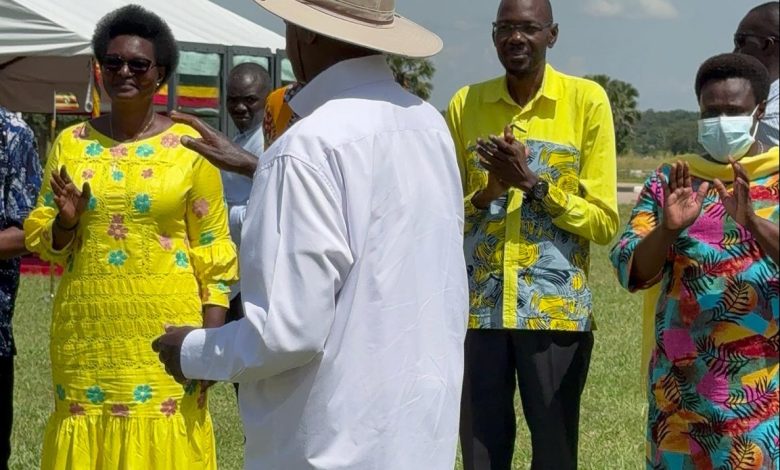
President Yoweri Museveni has moved to end the opposition-driven “no cow, no vote” campaign in the Teso sub-region by ordering that cattle compensation be paid per household rather than to individual claimants.
The new directive, announced during a stakeholders’ meeting at Soroti University on Friday the 15th of August 2025, is aimed at resolving the decades-long cattle loss dispute that has long been a political rallying point in the region.
Under the revised approach, every household will benefit from government restocking instead of compensation going only to verified individual claimants.
The pronouncement was received with ululation and loud endorsement from political, cultural, and opinion leaders across Teso, who welcomed it as a more inclusive and fair approach.
The President said the decision is intended to ensure fairness and reach more people, citing past payouts where some individuals received large sums while others got nothing.
“We don’t compensate for war or natural disasters,” Museveni told the gathering. “Our original line was rehabilitation and restocking. Now, rather than paying a few individuals, why not give something to every home in the area?”
Museveni proposed a select committee, chaired by Vice President Maj. Jessica Alupo and including elders, youths, and women to work with the Ministry of Justice to determine the exact amounts. He suggested a range of one to five million shillings, or the equivalent in cattle, per household.
Background to the Compensation Saga
Cattle compensation in Teso stems from livestock losses during the 1980s and 1990s due to the Lord’s Resistance Army insurgency and Karamojong cattle raids. In 2003, claimants from Acholi, Lango, and Teso sued the government for losses. This led to the creation of an inter-ministerial verification committee, replacing court-based mediation.
Deputy Attorney General Jackson Kafuuzi presented the latest figures to the President, revealing that between 2021 and 2025, the government has released 159.5 billion shillings for compensation across the three sub-regions. Teso alone has so far received 65.9 billion shillings, paid to 11,056 claimants. However, 10,708 verified claimants in Teso remain unpaid, with outstanding claims worth 195.9 billion shillings.
Kafuuzi noted that some payments have failed due to invalid account details, dormant or closed accounts, and cases of double claims. “Our verified liability across all regions now stands at 506.7 billion shillings,” he said, adding that 252.2 billion shillings’ worth of claims are still under investigation due to irregularities.
Stakeholder Reactions
Kaberamaido County MP Alfred Edakasi Elalu Olale welcomed the President’s approach, calling it more inclusive. “Previously, not many people benefited from the compensation.
This new method will open restocking to all households,” he said. He suggested that five cows per home could be a realistic starting point, though the final decision lies with the select committee.
However, Olale cautioned that the new model’s success depends on the government’s ability to release funds consistently, noting that in the past four years, allocations have been sporadic.
“The first year, Teso got 50 billion; the second year, nothing. Payments have been in bits as and when money becomes available,” he said.
He also advised that until the new system is implemented, the current verification and payment process should continue for those already in the queue.
“The President’s proposal is that if you were already compensated, you will not benefit again,” Olale explained.
By shifting the compensation model to cover every household, Museveni appears to have neutralized the opposition’s “no cow, no vote” campaign message, which has been used to rally discontent in Teso over the slow pace and perceived unfairness of individual payouts.
The Vice President’s committee is expected to report back to the President within a month with recommendations on the amount each household should receive.
According to the statistics from Uganda Bureau of Statistics, Teso Sub region has a total of 489,620 households. If each household restocked five cattle at a cost of 1,000,000 per cow, this would cost the government about 500 billion shillings.
This is on cattle restocking separate from rehabilitation since the President is now emphasizing restocking and rehabilitation as opposed to war compensation.


