

By Our Reporter
SERERE
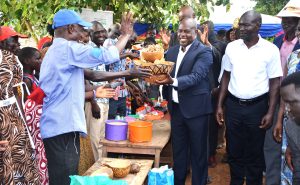
In a significant boost for Eastern Uganda, the launch of a major Community Seed Bank has reignited hope among local leaders and farmers dedicated to preserving indigenous seeds, particularly after the unfortunate decline of traditional granaries.
Situated in Alilimo village within the Kyere Town Council of Serere district, the Kyere community seed bank, built at a cost of about shs60 million, is poised to enhance the conservation of traditional seed varieties while improving access to top-notch planting materials.
This facility will act as a crucial resource for farmers, functioning as both an educational hub and a living archive of Uganda’s rich agricultural heritage.

The launch coincided with Uganda’s National Agroecology Festival 2025, themed “Agroecology for Inclusiveness, Social, Economic, and Environmental Sustenance,” aimed at promoting best agroecological practices among farmers, communities, and local leaders. This initiative highlights their vital role in environmental conservation and climate change mitigation.
At the launch, several speakers highlighted the timely arrival of the seed bank, noting that traditional granaries in the Teso sub-region have largely vanished due to theft and cattle rustling, which left many farmers without the bulls required to cultivate substantial food supplies.
During the official opening on Wednesday, 5th November, 2025, Stephen Ochola, the LCV District Chairperson for Serere, emphasized the alarming rise in health issues among young people attributed to poor eating habits, worsened by the loss of traditional foods that accompanied the decline of granaries.
He stated that the knowledge of food security, seed selection, and preservation was once prevalent in the Teso community, but he urged farmers to take full advantage of this new seed bank, which he claimed surpasses even the National Seed Bank in Entebbe in its scale.
Ochola described the seed bank as a significant milestone for the district and encouraged farmers to protect it diligently, noting its potential to reduce health risks associated with unhealthy eating.
The establishment and equipping of the seed bank were facilitated by the Eastern and Southern Africa Small Scale Farmer’s Forum (ESAFF-Uganda), with financial backing from the Norwegian Agency for Development Cooperation (Norad).
Robert Nyeko, the financial officer representing ESAFF, shared insights on the establishment of a seed bank aimed at preserving Uganda’s original indigenous seeds, which he emphasized as essential to farming in the country.
He pointed out that with the knowledge they gain from the seed bank, farmers will have the opportunity to multiply traditional seeds and enhance their families’ livelihoods.
“This is a learning point, and the skills gathered at the center should be shared across all households,” Nyeko remarked.
He urged district authorities to allow agricultural extension workers to assist farmers, stressing the importance of not leaving small-scale farmers to navigate challenges on their own. He believes that these farmers should lead in building a fair and resilient food system.
Nyeko called on farmers to take ownership of and manage the seed bank so that the valuable indigenous seeds can be accessed by all.
In support of this initiative, Anthony Nseko, the deputy Resident District Commissioner of Serere, encouraged farmers to engage in productive activities to ensure that the seed bank remains stocked. He emphasized that they must seize opportunities to market their seeds in bulk at competitive prices.
“It would be a shame if ESAFF arrives and finds the seed bank empty,” he stated.
Nyeko also noted that the government is committed to enhancing infrastructure, particularly roads, to facilitate the transportation of produce to various markets.
He commended ESAFF for its vital role in promoting climate health and body wellness, thus complementing government efforts.
Joyce Ketty Akello, chairperson of ESAFF Serere, coordinating ten farmer field schools in the district, spoke about the previous absence of a seed bank. She explained that without the bank, farmers often sold or consumed all their seeds without preservation. However, those challenges are now being addressed.
“We will now combat the issue of middlemen exploiting us,” she asserted.
Akello, who donated land for the seed bank, is confident that this facility will enable them to multiply indigenous seeds, such as groundnuts, and provide farmers with high-quality options.
She expressed hope that the government and NGOs would step in to assist, as climate change impacts their efforts in seed multiplication.
Margaret Amuge, chairperson of the Aitemitem farmers group, shared that the seed bank will help them conserve seeds, a task that has been difficult due to theft and damage from pests.
Janet Mary Apolot, a farmer from Kyere, expressed her gratitude, saying, “We have been crying day and night, but God has wiped our tears.”
Sam Elau, a farmer from Kamod-Bugondo sub-county, expressed that the insights gained from the seed bank will empower them to revive the diminishing seed varieties.
Hakim Baliraine, the National Chairperson of ESAFF-Uganda, encouraged farmers to contribute their diverse seed varieties to the bank.
He underscored the immediate need to assist farmers who are facing the challenges of climate change. “We must focus on preserving indigenous seeds to empower our local communities,” he remarked.
Baliraine stressed the significance of safeguarding these seeds and urged farmers to adopt agroecology—a farming practice that avoids synthetic fertilizers and pesticides. “Agroecology is about restoring balance.
By protecting our soils, conserving our seeds, and cultivating food in harmony with nature, we secure our future. Resilience starts with us,” he stated.
Hannington Lwandasa, an officer at the Plant Genetic Resources Centre (PGRC) within the National Agricultural Research Organisation (NARO), acknowledged that the seeds farmers preserve today lay the foundation for our food system.
He revealed that there are now a total of 30 community seed banks established across Uganda, with six constructed by ESAFF-Uganda alone. This, he said, marks a significant milestone in the shared vision of NARO and PGRC.
Lwandasa urged farmers to take action now to conserve seeds for future generations to ensure they have food to sustain themselves. John Emanio, the training coordinator at NaSARRI in Serere, emphasized the necessity of integrating agro-processing into the seed bank’s operations.
He noted that this would enhance farmers’ production capacity, enable them to collectively market their crops, and secure better prices, ultimately improving their incomes and quality of life.
Emanio also encouraged farmers to adopt agroforestry practices, highlighting their crucial role in alleviating the impacts of climate change.
“By embracing diversity through agroforestry, farmers can cultivate resilience and transition to more sustainable agricultural systems,” he pointed out.
During the launch, farmers from various districts including Serere, Amuru, Kampala, Amuria, Kasese, Kumi, Kabale, Mukono, and Gulu showcased a variety of traditional seed types.
According to the Uganda Bureau of Statistics (UBOS), Uganda’s agricultural sector is primarily composed of small-scale farmers, employing over 75 percent of the population and greatly contributing to export revenues and the national GDP.


