
By Weswa Ronnie
NATIONAL
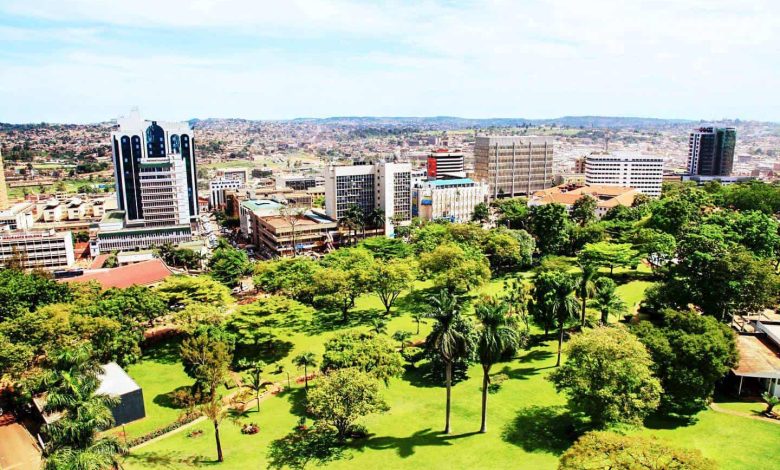
Cabinet has reversed a proposal to redevelop Kampala’s Constitution Square, popularly known as City Square, and resolved to retain the site’s existing legal status as a protected heritage area.
ICT and National Guidance Minister Justine Kasule Lumumba announced the decision at the Uganda Media Centre on today, Tuesday, 27th October, 2026 saying Cabinet had considered the site’s history, legal protection and environmental and urban planning implications before reaching its decision.
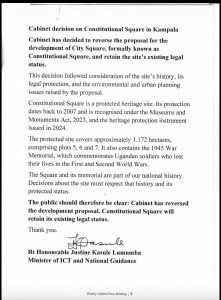
“The public should therefore be clear: Cabinet has reversed the development proposal. Constitution Square will retain its existing legal status,” the government statement said.
The decision taken on Monday, 26th October, 2026 halts a proposal to transform part of the city-centre public space into a commercial complex, following weeks of debate over the future of one of Kampala’s historically significant open spaces.
On August 30, 2026, President Museveni directed Minister for Kampala Capital City and Metropolitan Affairs Minsa Kabanda to examine a proposal by businessman Hassan Bulwadda to redevelop about two acres of the square into a modern, environmentally friendly complex featuring a hotel, shopping mall and other commercial facilities.
The directive required consultations with Kampala Capital City Authority (KCCA) before a report was submitted to the President.The proposal attracted public and political scrutiny, particularly over the potential impact on the square’s heritage status and its role as public open space in Kampala’s central business district.
On September 30, the Leader of the Opposition in Parliament, Joel Ssenyonyi, questioned the proposal, arguing that the city needed to protect its remaining green spaces and asking why Parliament had not been involved in the discussions.
Government subsequently said the proposal was still under review at that stage.Kampala Lord Mayor Ronald Balimwezo also opposed the redevelopment, arguing that the square should remain open for public use, recreation, environmental protection and emergency response.
The latest Cabinet decision settles the government’s position on the proposal by directing that the square retain its existing legal status.
According to the Cabinet brief presented by Lumumba, Constitution Square has been protected since 2007, with its status recognised under the Museums and Monuments Act, 2023, and a heritage protection instrument issued in 2024.
The protected area covers approximately 1.172 hectares, comprising plots 5, 6 and 7, and includes the 1945 War Memorial.
The memorial commemorates Ugandan soldiers who lost their lives during the First and Second World Wars, making the square a site of national historical significance.
The Museums and Monuments Act, 2023, provides a legal framework for the protection and preservation of Uganda’s cultural and natural heritage.
Section 21 specifically requires the responsible department to protect and preserve public monuments and memorials, while Section 26 places a duty on government ministries, departments, agencies and local governments to conserve and protect heritage sites and monuments.
The site’s protected status therefore has implications beyond its use as open space, placing its historical features within a broader framework for heritage conservation.
The decision also comes amid wider questions about the management of public land in Kampala, where commercial development, urban expansion and the need to preserve public spaces have increasingly featured in debates over the city’s future.
By reversing the redevelopment proposal, Cabinet has opted to retain the square under its existing legal protection rather than proceed with the proposed commercial transformation.
The government has not, in the supplied Cabinet statement, outlined any new plans for the square’s landscaping, maintenance or public use following the decision.
For now, the stated position is that Constitution Square will retain its existing legal status, preserving the site that houses the 1945 War Memorial and forms part of Kampala’s historical landscape.


