
By Nelly Otto
NAKASONGOLA
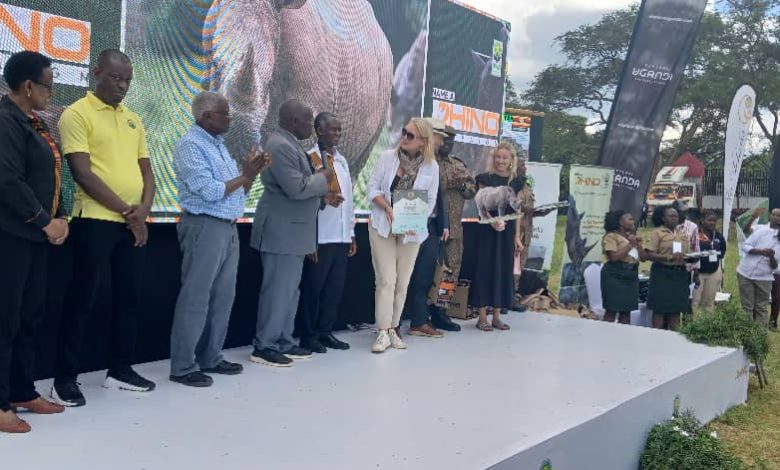
The British High Commissioner to Uganda, Her Excellency Lisa Chesney, delivered a powerful speech at the Rhino Naming Ceremony held at the Ziwa Rhino Sanctuary in Nakasongola.
The event which coincided with World Rhino Day (22nd September), celebrated the recovery of Uganda’s rhino population, which was once extinct in the wild, and highlighted the importance of conservation and tourism in driving the country’s economic growth.
The envoy praised Uganda for being a biodiversity superpower, hosting half of Africa’s bird species and over 40% of the continent’s mammal species.
According to multiple authoritative sources, Uganda has over 1,020 bird species, accounting for around 10% of the world’s species.
There are 345 mammal species, including chimpanzees and other iconic animals,142 reptile species and 86 amphibian species,501 fish species and 4,500 higher plant species and 1,242 butterfly species.
She commended the Uganda Wildlife Authority (UWA) and the Roy Family for their efforts in bringing rhinos back from local extinction to 48 today through a partnership between government, private sector, and conservationists.
UWA is a semi-autonomous government agency responsible for conserving, managing and regulating Uganda’s wildlife.
Established in 1996, UWA’s primary goal is to ensure sustainable management of wild life resources and supervise wildlife activities within and outside protected areas.
It is governed by a nine-member board of trustees appointed by the Minister of Tourism, Wildlife and antiquities.
The current Executive Director UWA is Dr James Musinguzi who was appointed on 1st April, 2025 replacing Sam Mwandha and the current board chair is a Makerere University College of natural Sciences (CONAS) don Prof James Kalema.
The British High Commissioner also emphasized the critical role of tourism in Uganda’s 10-fold growth strategy, citing the UK’s support for tourism-related infrastructure, including the Hoima-based Kabalega airport and tourism-supporting roads.
However, the British High Commissioner expressed her concern about the scale of poaching in Uganda, citing her recent visit to Murchison Falls National Park.
She commended the advice given by the Paramount Chief of Lango, HRH Eng. Dr. Michael Moses Odongo Okune, who urged citizens to stop poaching.
The High Commissioner emphasized that conservation and tourism can go hand-in-hand, supporting jobs and growth when do in harmony with local communities.
“…People can stop poaching…,” she said, highlighting the importance of collective action in protecting Uganda’s wildlife.
The High Commissioner’s remarks underscore the need for continued efforts to combat poaching and promote sustainable conservation practices.
By working together, the government, conservation organizations, and local communities can help safeguard Uganda’s rich biodiversity and unlock the economic benefits of tourism.
The UK’s support for conservation initiatives in Uganda demonstrates its commitment to protecting the country’s natural heritage and promoting sustainable development.
On climate resilience, Lisa Chesney highlighted the impact of climate change on wildlife and nature, and the UK’s commitment to working with the Government of Uganda to tackle this challenge.
She told the audience that her government UK has contributed approximately £20 million to conservation and tourism outcomes in Uganda since 1993, through initiatives such as the Darwin Initiative and Illegal Wildlife Trade (IWT) Challenge Fund.
Darwin Initiative provides funding for projects that conserve biodiversity and reduce poverty in eligible low0and middle0income countries like Uganda. It also supports projects that help developing countries meet their objectives under international agreements such as the Convention on Biological Diversity and CITES.
She also revealed that the British High Commission has also supported the Uganda Airlines direct flight from Gatwick to Entebbe, signaling the UK’s commitment to deepening ties with Uganda and facilitating trade and investment.
The British High Commission, in partnership with the Uganda Tourism Board (UTB) and UWA, hosted a Rhino Naming Dinner to champion conservation and tourism.
The event brought together members of the diplomatic corps, ambassadors, conservationists, and private sector leaders to discuss the critical role of conservation in advancing Uganda’s tourism growth.
The UK’s rhino was named Pearl, symbolizing Uganda’s unique biodiversity and the preciousness of its wildlife.
The event emphasized the importance of cross-sector collaboration and sustainable financing models to safeguard Uganda’s rhino population.
The Chief Executive Officer (CEO) Uganda Tourism Board (UTB)Juliana Kagwa reaffirmed the Board’s commitment to aligning conservation with tourism promotion, spotlighting conservation success stories to attract responsible travelers.
UTB is a government of Uganda agency responsible promoting and developing the country’s tourism industry. Its primary goal is to increase the country’s visibility as a premier tourist destination, boost visitor numbers and contribute to the national economy.
As the UK and Uganda work together to unlock new opportunities for trade, job creation, and innovation, the British High Commissioner’s speech served as a powerful reminder of the importance of conservation and tourism in driving sustainable development.
Who Is Lisa Chesney?
Her Excellency Lisa Chesney who was appointed British High Commissioner to Uganda in October 2024 succeeded Kate Airey (Officer of the Order of the British Empire (OBE).
She has extensive experience in international diplomacy having served in various roles including British High Commissioner to Sierra Leone (2021-2024), Deputy Head of Mission in Somali’s Mogadishu and Head of Politics and Strategic Communications in Helmand province, Afghanistan.
Lisa Chesney also worked in counter-terrorism leading the Counter-Extremism Unit at the Home office from 2018 to 2020 and leading the Prevent Team in the Counter-Terrorism Department at the FCO.
Uganda and the United Kingdom have a longstanding and dynamic relationship with cooperation in various sectors. Uganda has a high commission in London while the UK has a high commission in Kampala.
The UK provides significant development aid to Uganda focusing on areas such as promoting good governance and combating corruption. Improving maternal and reproductive health and responding to health emergencies.
The UK has also been supporting economic growth, job creation and increasing access to financial services, tackling climate change and promoting renewable energy.
The UK is a big trading partner for Uganda with total trade in goods and services valued at approximately 500 million pounds. The UK also provides assistance to British and Ugandan businesses through the UK Department for International Trade.
The UK and Uganda cooperate on security issues including military training in shaping Uganda Defense Forces. There are strong people-to-people links between the two countries with an estimated 51,000 Ugandans living in the UK and 3,000 British nationals residing in Uganda.
Both the UK and Uganda have emphasized their commitment to fostering cooperation and mutual growth with the recent high-level meetings strengthening bilateral ties.
Overall, the relationship between Uganda and the UK is built on shared interests, mutual respect and a desire for cooperation and development.


