
By Leonard Mukooli
KAMPALA
The Minister for Water and Environment, Sam Cheptoris, has warned that Uganda risks sliding into what he described as a “slow environmental suicide” if urgent measures are not taken to protect and preserve the country’s natural resources.
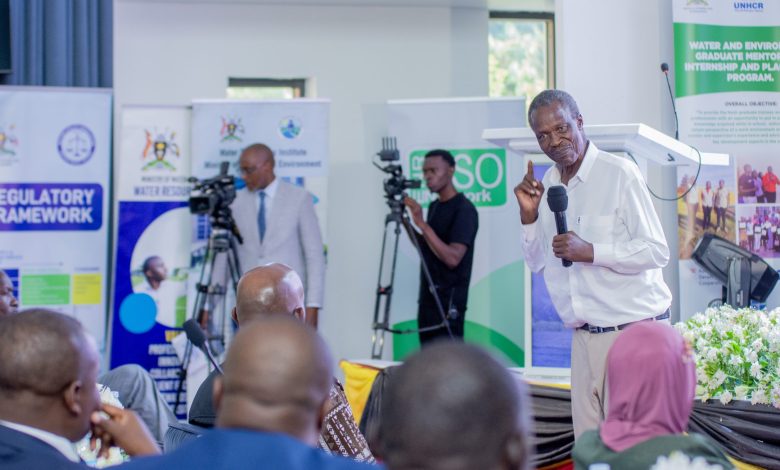
Cheptoris made the remarks during the closure of the week-long Uganda Water and Environment Week at the ministry headquarters in Luzira, Kampala. The event brought together key stakeholders in the water and environment sector to reflect on progress, challenges, and emerging opportunities.
The week also marked the commemoration of three global observances: World Water Day, World Meteorological Day, and the International Day of Forests.
In a candid address, Cheptoris challenged government officials and development partners to rethink how environmental messages are communicated to the public, warning that technical discussions often fail to reach the communities most responsible for environmental degradation.
“We are not addressing ourselves here in this auditorium,” he said. “Whatever we discuss must reach the ordinary Ugandan. Let us avoid complicated language and speak in a way that changes behaviour on the ground.”
He stressed that local actions primarily drive environmental destruction and urged the implementation of communication strategies that directly engage communities.
“We must speak to the person destroying the environment in a language they understand,” he added.
Alarm over wetland destruction
The minister expressed concern over the increasing encroachment on wetlands, describing it as one of the most visible and dangerous forms of environmental degradation.
“It is shocking to see soil being poured into wetlands just to put up buildings,” he said. “This is happening every day, yet we fully understand the value of these ecosystems.”
He warned that continued destruction of wetlands threatens water systems, biodiversity, and long-term environmental sustainability.
Drawing from personal experience, Cheptoris linked environmental degradation to rising health risks, noting that pollution is increasingly affecting food quality and public health.
“I have been unwell for some time, and while abroad, I was advised to rely on organic food,” he said. “But with the level of pollution we are experiencing from vehicle emissions to other contaminants, it raises serious concerns about what we consume.”
Air pollution and ‘slow death’
Cheptoris painted a stark picture of the country’s air quality, blaming ageing vehicles and unregulated emissions for what he described as a growing public health crisis.
“As a country, we are undergoing a slow death,” he said. “Too many old vehicles on our roads are releasing dangerous fumes that are affecting the air we breathe and the quality of life we live.”
In a remark that drew mixed reactions from the audience, he criticised the continued use of outdated vehicles.
“You find someone driving a very old car, and you wonder, why are you exposing the rest of us to such risks?” he said. “Pollution is linked to cancer and many other diseases.”
He dismissed the perception that environmental protection is less stringent in developed countries, arguing instead that strict enforcement is what has enabled their progress.
“In Europe, cities are surrounded by forests, and environmental laws are strictly enforced,” he said. “Here, everyone wants to drive, regardless of the impact.”
Cheptoris proposed a cultural shift towards cleaner transport alternatives, including cycling.
“If it were up to me, I would remove old vehicles from the roads,” he said. “Those who cannot afford cleaner options should consider alternatives like bicycles.”
He also criticised the environmental impact of boda-bodas, linking their emissions to indoor air pollution.
“The fumes from these motorcycles are no different from the smoke people inhale in kitchens,” he said. “We are exposing ourselves to long-term health risks.”
“We are destroying the environment with our own hands,” he added. “And in doing so, we are slowly destroying ourselves.”
Economic implications
The Minister of Finance, Planning and Economic Development, Matia Kasaija, said environmental protection is central to Uganda’s economic transformation.
He noted that the theme of this year’s event, Water and Environment for a Prosperous Uganda, reflects the country’s long-term development priorities.
“This is not just a slogan,” Kasaija said. “It is a clear statement that our prosperity depends on how well we manage our natural resources.”
He warned that environmental degradation is already imposing significant costs on the economy, undermining development efforts.
“Our growth ambitions are directly tied to the health of our environment,” he said.
Kasaija outlined Uganda’s plan to grow its economy from $50 billion in 2025 to $500 billion by 2040, anchored on agro-industrialisation, tourism, mineral development, and science and technology.
However, he cautioned that these sectors rely heavily on sustainable water and environmental systems.
“You cannot achieve agro-industrialisation without reliable water for irrigation,” he said. “Tourism depends on intact ecosystems, while industrial development also requires significant water resources.”
“It will be impossible to achieve this growth without protecting our environment,” he added.
Call for investment and inclusion.
Kasaija stressed the need for increased investment in water infrastructure, particularly storage and distribution systems, to improve access across the country.
“Water is a basic human right,” he said. “We must ensure that rural communities, women, and the youth are not left behind.”
He also emphasised the importance of protecting wetlands, forests, and catchment areas.
“These are not optional investments,” he said. “They are essential for agriculture, energy, and tourism, the key drivers of our economy.”
The minister further called for greater collaboration between the government, the private sector, civil society, and communities.
“Government cannot do this alone,” he said. “We need collective action and innovative solutions to address pollution and climate change.”
Gender and water access
Dr Eng. Frank Kweronda highlighted the link between water access and gender inequality during the World Water Day commemoration.
“Water is not just a resource; it is a matter of dignity, justice, and equality,” he said.
He noted that women and girls bear the greatest burden of water collection, often at the expense of education and economic opportunities.
“This limits their potential and exposes them to risks,” he said.
Kweronda called for deliberate efforts to empower women and ensure equitable access to water services.
Climate change concerns
Dr Bob Alex Ogwang warned that Uganda is already experiencing the effects of climate change, with rising temperatures and unpredictable rainfall patterns.
“Extreme weather events such as floods, droughts, and landslides are becoming more frequent and more intense,” he said.
He urged the protection of wetlands and forests, noting their critical role in regulating climate systems.
A shared responsibility
Alfred Okot Okidi, the Permanent Secretary at the Ministry of Water and Environment, called for a collective approach to environmental protection.
“Our development depends on natural resources, but mismanagement and climate change are putting the future at risk,” he said.
He emphasised that safeguarding the environment is not the government’s sole responsibility.
“Such work is a shared duty,” he said. “We must all act to stop the gradual destruction of our natural resources.”


