
By Emmanuel Okol
Washington, D.C.
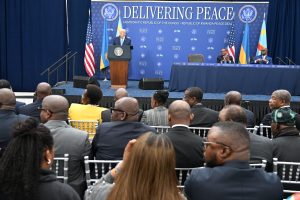
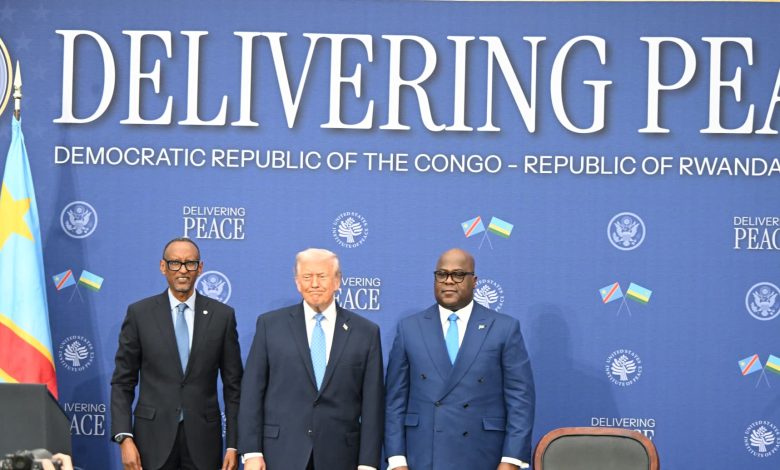
Uganda has applauded the landmark peace agreement signed at the White House on Thursday, 4th December, 2025 where United States President Donald Trump hosted Rwandan President Paul Kagame and Democratic Republic of Congo President Félix Tshisekedi for what has been widely described as a historic stride toward lasting regional peace and stability.
President Yoweri Kaguta Museveni, who was officially represented by Vice President H.E. Jessica Alupo, congratulated the three leaders—Trump, Kagame, and Tshisekedi—for their foresight, courage, and commitment to resolving long-standing conflicts that have strained the Great Lakes Region for decades.
Despite a tight program that did not allow Vice President Alupo to deliver her prepared speech, copies of her remarks were circulated among diplomats and delegates — and quickly became a central topic of discussion. The clarity, depth, and strategic insight contained in her written message drew admiration, reinforcing her stature as one of the most distinguished and influential leaders present.
Alupo’s presence itself commanded notable attention from observers and regional stakeholders. She carried Uganda’s diplomatic weight with composure and authority, reaffirming the country’s central role in advocating for durable peace and regional cooperation.
In his message, President Museveni saluted President Trump for appreciating what many African nations have long observed: that much of Africa’s instability has been driven by *“parasite actors”* who fuel tribal and religious identity politics rather than advancing unity, development, and shared prosperity. Such distortions, he noted, have historically weakened African states, obstructed institutional growth, and prolonged unnecessary conflicts.
Reflecting on Uganda’s own history, Museveni explained that the country once faced similar ideological confusion until the nationalist student movements of the 1960s—led by him and other young patriots—highlighted the dangers of sectarianism and laid out four guiding principles for national progress: Patriotism, Pan-Africanism, Social-Economic Transformation, and Democracy. These principles, he said, remain the backbone of Uganda’s development and resilience.
Museveni further criticized the continental trend of resorting to armed conflict as a first response to political grievances, comparing it to prescribing surgery for minor illnesses. He condemned leaders who seek foreign sponsors for internal disputes instead of engaging their citizens constructively to find sustainable, win-win solutions.
He applauded President Tshisekedi, President Kagame, and the M23 leadership for embracing peace, and commended the United States—particularly President Trump—for steering the breakthrough agreement.
However, the President cautioned that the journey toward full stability is far from complete. While the M23 issue marks a major milestone, unresolved conflicts in Ituri, North Kivu, and South Kivu continue to threaten the region’s stability. Uganda currently hosts over 642,770 Congolese refugees, a reality Museveni emphasized as further evidence of the urgent need for comprehensive solutions that will allow Congolese citizens to return home safely and confidently.
Through the written speech shared at the event, Vice President Alupo reaffirmed Uganda’s unwavering commitment to supporting regional peacebuilding, strengthening Pan-African solidarity, and advancing collective security. Her sharp articulation of Uganda’s position, even without a spoken address, made her one of the most outstanding leaders at the ceremony and underscored Uganda’s rising influence in regional diplomacy.
She described the signing as a pivotal turning point for the Great Lakes Region — a demonstration of what can be achieved when leaders choose dialogue, partnership, and shared prosperity over conflict.
“Uganda stands ready to work with all partners to ensure this agreement leads to lasting peace,” Museveni said through Alupo’s circulated remarks.
The ceremony concluded with renewed optimism as the signatories pledged to fully implement the accord, raising hopes for a new era of peace, stability, and cooperation in Central and Eastern Africa.


